
Effectiveness of the Gimnasio Campestre evaluation products as tools for the ongoing assessment of students
- M in Education, Homeroom teacher, Gimnasio Campestre
- M in Theology, bilingual teacher Gimnasio Campestre
- Ma in Psichology, Homeroom teacher, Gimnasio Campestre
Correspondencia para los autores: maldana@campestre.edu.co, ghernandez@campestre.edu.co, msefer@campestre.edu.co
Recibido: 4 de junio de 2025
Aceptado: 7 de junio de 2025

Table of Contents
RESUMEN
Esta investigación pretende evaluar si los productos en el Gimnasio Campestre logran alcanzar los objetivos de lo que las investigaciones recientes han demostrado que funciona para la enseñanza de los estudiantes jóvenes. Las tendencias recientes en educación plantean cómo debe ser el proceso de enseñanza-aprendizaje dentro del salón de clase. Estos estudios, para el caso de esta investigación “Enseñanza para la Comprensión” específicamente, muestran que debe haber una interacción entre profesores y estudiantes cuando se da este proceso, de tal forma que los estudiantes entiendan cuál es el propósito de éste y el profesor pueda tener información clara sobre lo que está pasando.
Los profesores en el Gimnasio Campestre usan los “productos” como herramienta de evaluación para revisar si los estudiantes están aprendiendo lo que deben y necesitan, y esta investigación examina la eficacia de estos productos, bajo los estándares de Enseñanza para la Comprensión.
Palabras clave: Gimnasio Campestre, Enseñanza para la comprensión (TFU), Modelo Pedagógico, Productos, evaluación.
ABSTRACT
This research wanted to evaluate if the products at Gimnasio Campestre fulfill what new investigations have proven to be effective to teach young learners. New trends in education talk about how the teaching-learning process should happen in the classroom. These studies, specifically Teaching for Understanding, show that there must be an interaction between learners and teachers while this process is happening, so learners understand what the purpose is and teachers do various observations in order to guarantee that the process is happening and for teachers to see how it is going.
Products at Gimnasio Campestre are the instrument teachers have to test if students are learning what they must and need to, and this study examinates how effective, in light of Teaching for Understanding, these products are being.
Key Words: Gimnasio Campestre, Teaching for Understanding, The Pedagogical Model, Products, Assessment.
The evaluation system at Gimnasio Campestre is an “integral, continuous, systematic, flexible, participatory, and formative process that takes into account the progress of every one of the students”

INTRODUCTION
In an increasingly interconnected and dynamic world, recent theory agrees that education must evolve to help students acquire critical thinking and problem-solving skills for the 21st century. Assessment is now considered part of the learning process, which needs continuous monitoring. Various authors through the latter years, have studied the effects of different methodologies in order to achieve the teaching-learning goals when working with all ages learners. This study examines the effectiveness of some of the assessment products at Gimnasio Campestre, specifically in the third grade «Language Arts» program, as a tool to ensure continuous assessment. The study uses the «Teaching for Understanding» (TFU) framework to qualitatively analyze two assessment products to assess the extent to which they facilitate continuous assessment through feedback, reflection, student responses, and improvement plans.
GUIDING FRAMEWORK (THEORY)
One of the most interesting topics to study in educational research is the evaluation process and its appropriate tools. The educational community has been in search of innovative methodologies, and it has turned its attention to comprehensive performance evaluations that answer to the novelties in other educational processes. Gimnasio Campestre has, as well, wondered about the most appropriate evaluation process for its students, and this inquiry hopes to understand its efficacy considering a particular theory in education: teaching for understanding.
Evaluation at Gimnasio Campestre is grounded in contemporary educational theories that underscore the importance of ongoing and formative assessment practices. According to Hattie and Brown (2012)1, assessment is the process of identifying the characteristics of a trait, focusing on the fundamental question of «What’s so?» in relation to student learning. On the other hand, the same authors claim that evaluation involves establishing the value and worth of a product, process, person, policy, or program, prompting the inquiry «So what?». At Gimnasio Campestre, assessment and evaluation are synonyms as they are the processes that provide significant information to value and make decisions within the process of educational activities (The Pedagogical Model, 2023)2.
Hattie and Brown argue that both -assessment and evaluation- hinge on high-quality measurement and revolve around the qualities, degrees, and characteristics of student learning, aligned with societal importance and curriculum objectives. For them, assessing and evaluating learning depends on the design and usage of appropriate methods to collect information about learning (Hattie & Brown, 2012).
The evaluation system at Gimnasio Campestre is an “integral, continuous, systematic, flexible, participatory, and formative process that takes into account the progress of every one of the students” (The Pedagogical Model, 2023). The principal characteristic of it, is that it is based on the philosophy of formative evaluation, which considers evaluation not as a secondary idea, “but rather as a part of the curricular contents of the learning process” (p.31).
The learning process in Gimnasio Campestre consists of the acquisition and assimilation of knowledge, skills, and abilities by the student. Much like Teaching for Understanding, it involves various strategies and methods, including cognitive and metacognitive strategies including, to understand, process, and commit information to memory for future use (p.28). The learning process is seen as a dynamic, contextualized, and investigative process that promotes the development of competencies and complex thinking (p. 3). This includes the processes by which students learn to evaluate themselves validly, making an autonomous evaluation to recognize their advances (p. 32). Considering this, evaluation “must be understood as a natural and inseparable process from learning and not as an external process that takes place after learning», because it serves in the construction of knowledge, critical thinking, and the integration of different disciplines.
This type of evaluation has been theorized and has been called many things, one of these being formative evaluation. According to the Pedagogical Model, Gimnasio Campestre’s (2023) formative evaluation is a cyclic process by which students collect meaningful information about their learning process to make value judgments and assessment decisions that will help them improve (p. 31). It differs from traditional evaluation methods because it is aimed towards promoting student learning and involves evaluating oneself validly, learning evaluation techniques, and adapting them to one’s learning process, in order to aid students, improve their performance.
To accomplish this, Gimnasio Campestre determines for each grade the “Mapa de Dominio de Competencias”, the disciplinary contexts of each subject and a set of performance evidence (Products). “Products” are the pre-established quality criteria to measure, through concrete evidence, the student’s performance.
As aforementioned, the Pedagogical model at Gimnasio Campestre is based on competency-based learning. Even though the two are closely related, each framework and model is different and can be used in a variety of situations and contexts.
Teaching for understanding is a framework that was designed and originated in 1998 by researchers at the Harvard Graduate School of Education (Fusaro, 2008)3. The core dimension of this framework is what educators would agree on, on what good teaching ought to be (Fusaro, 2008). According to Tina Blythe and David Perkins, creators of the same “The teaching for understanding framework is a representation of what good teaching is. It captures what good teachers do so that we can take gut feelings and make them more explicit and visible” (Fusaro, 2008).
Since its design and use within many areas Teaching for Understanding (from now on referred to as TFU) has been evolving consistently in order to better meet the needs of both educators and students alike. TFU calls for a fundamental shift from a content-based teaching approach, to making learning more transferable and teaching abilities, ideas, skills and processes to make sure students have what is necessary for the future (Fusaro, 2008). TFU calls for students to learn ideas that they can use and apply flexibly and autonomously throughout their career and life (McTighe and Seif, 2014)4. The goal of learning therefore in the TFU framework is to make it transferable to other contexts (McTighe and Seif, 2014).
The structure and framework of TFU means that throughout the academic year teachers can return to the framework to help ensure that instructional comments are being addressed systematically (Fusaro, 2008). As Fusaro claims in this article, TFU has a number of guidelines which can be used and applied in all grade levels and areas and are a framework that teachers can use to create a classroom which fosters deep learning. These include the following:
- Generative topics- what is worth teaching?
- Understanding goals – unit sized goals.
- Performance of understanding- things that both develop and demonstrate understanding. Over time this becomes more complex.
- Ongoing assessment- understanding and assessment go hand in hand. Assessment and feedback are opportunities for reflection. An integration of performance and feedback is what students need for their understanding of information (Blythe, 1999)5. This provides students with clear responses on their performance and understanding how they can improve for the next time (Fusaro, 2008).
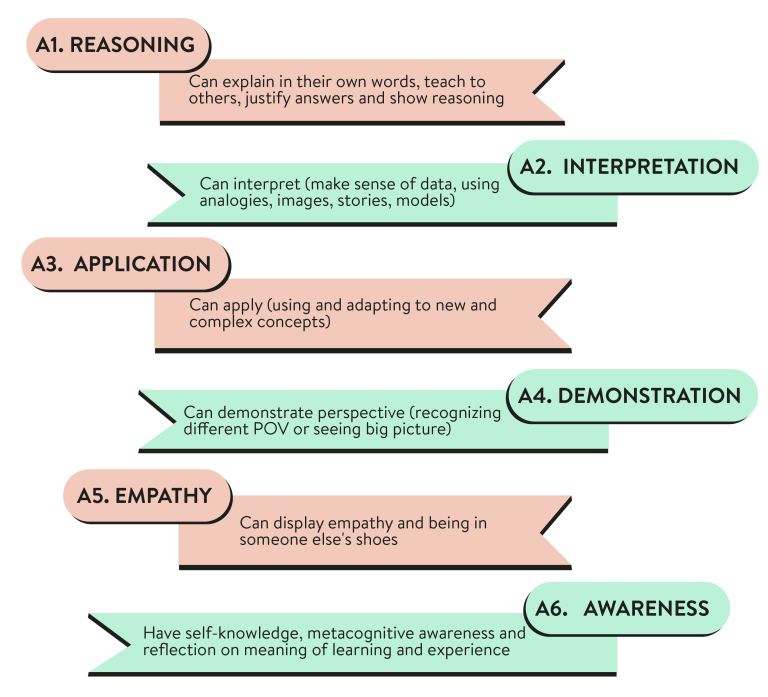
The framework also very clearly states that, when students understand information that is being taught, they can: explain their own words (teach to others, justify answers and show reasoning, interpret (make sense of data, using analogies, images, stories, models), apply (using and adapting to new and complex concepts), demonstrate perspective (recognizing different points of view or seeing big picture), display empathy and being in someone else’s shoes and finally have self-knowledge, metacognitive awareness and reflection on meaning of learning and experience.
TFU has clearly shown to deepen students understanding (McTighe and Seif, 2014). The more opportunities there are for interaction, the greater the learning is (McTighe and Seif, 2014). Engaged learners construct their own understanding around ideas and questions that they may have or arise (McTighe and Seif, 2014).
In TFU «performances of understanding and student assessment go hand-in-hand» (Fusaro, 2008). Rather than evaluating just outcomes at the end of a specific period. It believes in an ongoing process that involves: the socialization of the assessment criteria for the students, constant feedback from the teacher, and teacher and students’ opportunity to reflect on the students’ progress and barriers for their understanding.
Considering this, assessment is a process aimed at improving students’ learning and teachers’ understanding of the student’s needs and struggles. Socialization of the assessment criteria for the students is a tool for teachers to define «appropriate criteria and high standards for learning quality» and can also help students understand the expectations of a specific assessment1 (Angelo, 1995, p.7)6. Constant feedback from the teacher is also helpful for both the teacher and the student. The teachers can make instructional adjustments while giving feedback, and students can improve their understanding and performance (Center for Teaching & Learning, n.d) (Guskey, 2013)7. Finally, the teacher and students’ opportunity to reflect on the student’s progress is a process that can help teachers identify the areas where students are in need of additional support to meet the expectations. Reflection allows students to think about their learning process and disposition for learning, as well as to think about what they have learned and how it can be useful in their lives.
To fulfill these criteria, teachers need to use various tools «such as assignments, observations, class discussions, tests, and quizzes» (Guskey, 2013) to gather enough data and information that they can use to follow the student process and then evaluate.
Based on this research, Ongoing Assessment is a powerful tool to be used for both students and teachers alike. GC is an educational institution that has always strived for innovation and keeping up with the newest and most successful strategies that help both students and teachers. Due to this, the researchers decided to study the Pedagogical Model and how aligned this is with both ongoing assessment and teaching for understanding.
In a rapidly interconnected and changing world, preparing students for the 21st century is the main goal of education. The field of education, as always, is evolving and changing along with our students. Educational staff want their students to be independent so that they won’t need teachers anymore. The major goal of leaning is to enable students to use their knowledge in a wider world beyond school and the classroom (McTighe and Seif, 2014). In accordance with this, Gimnasio Campestre has become a leading institution in wanting to prepare its students for this “new” and interconnected and interchanging world.
Gimnasio Campestre has described and defined their pedagogical model on four different competences which students must develop and master. These are universal competences that provide students with abilities and skills that are transversal and can be applied to any and all subjects and contexts. These competences are:
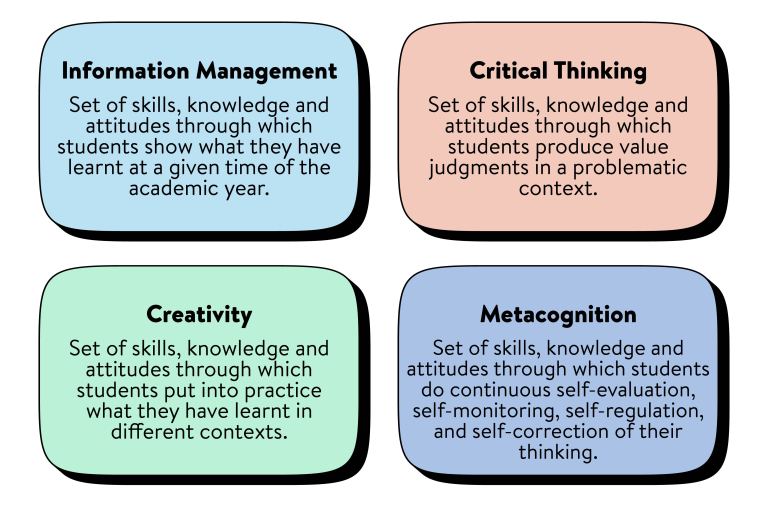
These four (4) competences are assessed though products that evaluate one or more of each of them. Each term all four (4) must be assessed in at least 3 different moments.
During each term of the year, teachers can choose products from a database in Phidias (the school’s virtual platform). Teachers may choose to use the same or different products. These depend on the term and unit planning as well as the contexts being covered in the class. These products and their performance evidence are used to evaluate the performance of the students throughout the different evaluation moments. Products and evidence change in content, complexity and necessities each year.
In third grade for the Language Arts program, these products include:
As described in Phidias, “The GC exploration workshop seeks that students constantly develop experimentation, field work and in general the exercise of inductive reasoning as a fundamental didactic principle, contemplated in the curriculum of Gimnasio Campestre”.
As described in Phidias, “This product aims to develop students’ identification of valid statements, by helping them differentiate between an opinion and a fact. Through the inquiry cycle, students explore both implicit and explicit elements of statements.”
As described in Phidias, “This product is designed to assess students’ acquisition of grammar (morphosyntactic) structures and spelling rules. These structures and rules are described and scaffolded throughout the curriculum.” This product intends to help students acquire grammar in a proper way using different communicative tasks, and help teachers assess that acquisition.
As described in Phidias, “It assesses two competences: Information Management and Metacognition… centres around the performance during training sessions and tests, while the latter focuses on how the metacognition process can help him improve his results.” This is an international test in which the students will be graded according to what they are expected to do at their grade level.
As described in Phidias, “This product assesses students’ mastery of the content proposed as well as the standards established by Network.”. This means that students will show in their answers on this test, how much they know about
As described in Phidias, “The goal of this product is for students to be able to recognise real events, through time and properly place them on timelines. Students are also expected to recognise the order of events. Finally, students make predictions about the effect that changes in events have on the outcomes.” This product is used to show students’ progress in understanding what they read in the reading plan.
As described in Phidias, “This product aims to strengthen critical thinking and language skills using stories as a doorway for making sense of the world.”. In this product, the students make up their own story showing appropriation of all the story elements they learnt in class, and the vocabulary needed to do so.
As described in Phidias, “This product allows the student to demonstrate that he has read and understood and, above all, that he/she is able to select a topic, ideas and main vocabulary.”. This product can also be used to test the books from the reading plan. There are three books that are read through the year, and this product helps test the students’ understanding of the main ideas from each one.
At Gimnasio Campestre, the school year consists of three terms, each composed of 13 weeks. Each term has three different moments in which the students are assessed and evaluated. At times an evaluation includes all competences, whereas as times one or just a few competences are evaluated. For each of these moments, the teachers can choose one or more of the products described above, to test the knowledge and advancement of students which must be related to what has been practised during the term, according to the topics that have been taught.
MATERIALS AND METHOD
The participants in this case study involved 22 boys between the ages of 9-10, from Gimnasio Campestre, a private school in Bogota Colombia. All participants were second language English learners, from an affluent socioeconomic group.
Ethics approval was obtained before the recruitment process and the recruitment was due to convenience. Subjects did not receive any compensation for their time, since all was completed as part of the curriculum at school.
For this qualitative study, the researchers analyzed some of the products (evaluations) from the Language Arts program in third grade over the course of an academic term (3 months). Specifically, the products of sequencing patterns and storytelling were utilized.
First, each product was analyzed to see how relevant it is in order to comply with the framework of TFU. These included objectives that students should be able to do the following:
Then the researchers examined the previously mentioned products using one specific category of TFU for analysis. Each product was analyzed by the researchers in its level of compliance with the concept of ongoing assessment which states:
“Ongoing assessment- understanding and assessment go hand in hand. Assessment and feedback are opportunities for reflection. The integration of performance and feedback is what students need for their understanding of information (Blythe, 1999). This provides students with clear responses on their performance and understanding how they can improve for the next time (Fusaro, 2008).”
To verify if the two products were selected are effective for ongoing assesment the study determined four categories:

Additionally, to obtain a deeper understanding of the ongoing assessment of these products, the researchers determined whether each criteria (feedback, reflection, responses, improvement, and socialization) was explicitly outlined by the product specifications or if it was the initiative of the teacher. These distinctions helped the researchers understand the extent to which ongoing assessment is crucial for the studied products.
Finally, structured interviews were conducted with 2 randomly selected focus groups from the 22 students who participated. The questions asked were:
- What was the objective of this timeline?
- How could you apply the information learned?
- How did you get prepared for this project?
- What did this timeline assess?
- How did you demonstrate what you learned?
- What did you think of this project?
The interview was carried out to understand the point of view of students regarding their evaluation and gain more understanding of their processes. Students were asked these questions to attain a deeper understanding of the student’s process from his point of view and not only the teachers.
RESULTS
The following tables evaluate two Language Arts products: Storytelling and Sequencing and patterns, against the principles of Teaching for Understanding (TFU). These principles assess how well a product fosters deep learning and transferable skills. The researchers analyzed each product based on five key categories: A1. Reasoning, A2. Interpretation, A3. Application, A4. Demonstration, A5. Empathy, A6. Awareness (tables 1 and 3).
Furthermore, both products were also analyzed with the principles of ongoing assessment which included: B1. Feedback, B2. Reflection, B3. Responses, B4. Improvement and B5. Socialization. These criteria were defined according to the ongoing assessment definition for TFU.
Storytelling and Teaching for Understanding
| Desired Outcome | Description of the Outcome | Rating (1: Not Evident 2: Somewhat Evident 3: Mostly Evident 4: Strongly Evident) |
|---|---|---|
|
A1. Reasoning |
Students can explain, justify, teach others, and demonstrate reasoning. |
4 |
|
A2. Interpretation |
Students can make sense of information using various tools. |
3 |
|
A3. Application |
Students can use and adapt their knowledge to new and complex situations. |
3 |
|
A4. Demonstration |
Students can recognize different perspectives and see the bigger picture. |
1 |
|
A5. Empathy |
Students can understand and consider different viewpoints. |
1 |
|
A6. Awareness |
Students demonstrate metacognitive reflection on learning and experiences. |
4 |
Table 1
Storytelling and Ongoing Assessment
| Categories | Description of the category | Specified as part of the product: (1: Not Evident 2: Somewhat Evident 3: Mostly Evident 4: Strongly Evident) | Done by the teacher (Yes/No |
|---|---|---|---|
|
B1. Feedback |
The process of providing information to students about their performance and progress on a regular basis |
4 |
Yes |
|
B2. Reflection |
Students may edit, change and reflect upon their own work |
4 |
Yes |
|
B3. Responses |
There are clear and concise responses by the student and teacher |
2 |
Yes |
|
B4. Improvement |
There are opportunities for students to map out their strategic plans for the development of the product |
4 |
Yes |
|
B5. Socialization |
Students know how they will be assessed |
4 |
Yes |
Table 2
Storytelling and Ongoing Assessment
| Desired Outcome | Description of the Outcome | Rating 1: Not Evident 2: Somewhat Evident 3: Mostly Evident 4: Strongly Evident) |
|---|---|---|
|
A1. Reasoning |
Students can explain, justify, teach others, and demonstrate reasoning. |
4 |
|
A2. Interpretation |
Students can make sense of information using various tools. |
2 |
|
A3. Application |
Students can use and adapt their knowledge to new and complex
situations.
|
2 |
|
A4. Demonstration |
Students can recognize different perspectives and see the bigger picture. |
1 |
|
A6. Awareness |
Students can understand and consider different viewpoints. |
2 |
|
A5. Empathy |
Students demonstrate metacognitive reflection on learning and experiences. |
4 |
Table 3
Sequencing and patterns and Ongoing assessment
| Categories | Description of the category | Specified as part of the product: (1: Not Evident 2: Somewhat Evident 3: Mostly Evident 4: Strongly Evident) | Done by the teacher (Yes/No |
|---|---|---|---|
|
B1. Feedback |
The process of providing information to students about their performance and progress on a regular basis |
2 |
Yes |
|
B2. Reflection |
Students may edit, change and reflect upon their own work |
2 |
Yes |
|
B3. Responses |
There are clear and concise responses by the student and teacher |
2 |
Yes |
|
B4. Improvement |
There are opportunities for students to map out their strategic plans for the development of the product |
3 |
Yes |
|
B5. Socialization |
Students know how they will be assessed |
4 |
Yes |
Table 4
DISCUSSION (RESULTS ANALYSIS)
From table 1 the researchers concluded that «Storytelling» evaluation is a strong tool for developing reasoning and metacognitive skills in students. It offers opportunities for the students to explain and justify concepts by applying different strategies and following steps to complete the activity, which can strengthen reasoning skills. It also provides opportunities for students to reflect on their understanding and learning processes, check if their work is complete and correct with a checklist, and use those reflections as significant to correct and improve their work. The evaluation can also be somewhat helpful for the interpretation of information and its application. The two-part evaluation helps students use various tools and methods to represent information, but also to apply the knowledge, first shown in the written part, then, in the comic.
While the product helps foster reasoning, metacognition, and some interpretation and application skills, its effectiveness for demonstration and empathy is limited. Those areas could be further improved to ensure students can recognize different perspectives other than their own and also consider different points of view. This can help teachers and educators see how students can relate their knowledge in different contexts, as it requires students to synthesize, analyze, and connect information for new applications. Empathy can also help students develop critical thinking skills, it allows students to understand and connect with peers and fosters collaboration and effective communication. Educators and teachers can use students’ empathy to understand their ability to use their knowledge to approach challenges.
Continuing along this line and seen in Table 2, storytelling was also analyzed using the competencies of ongoing assessment. As can be seen, throughout the process of the product, students received feedback, both from their teacher as well a peer. The peer evaluation was given specific criteria that students had to check for as well as completing a checklist and letting their peer know where and how they can improve. Students then also had to write what they would change in their final product once the feedback was received. Students therefore had the opportunity to reflect, edit and make any appropriate changes based on that information given to them. This was clearly an improvement plan which students had the opportunities and plenty of time to comply with. When analyzing clear responses, it was a little more difficult to evidence, as this was a class taught in a second language. Therefore, at times the information is not as clear and concise, specifically in the peer feedback. Students struggle giving adequate, appropriate and pragmatic feedback in a second language. Lastly, when analyzing the assessment criteria for students, this was clearly stipulated and explained to students before beginning their product. The criteria were displayed daily in the classroom (projected on the board), and students were given a clear checklist which they had to complete as they completed their product or upon total completion. The general conclusion shows that this product met the requirements of ongoing assessment, although as always there is room for improvement.


“Sequencing and patterns” is a product for students to be able to recognize events and properly organize them on a timeline, to then make predictions about the effects and outcome of those events. From Table 2, it is clear that this product offers strong opportunities for students to explain and justify their reasoning, as well as opportunities to make sense of information, representing the information through the timeline. The product could improve on showcasing student understanding through various methods of the application of knowledge to different situations. The activity does not encourage students to consider different perspectives or evidence that requires them to analyze information from multiple sources. The analysis done about the effects and outcomes of the events by which students consider the consequences of eating healthy helps students consider their actions and decisions, nonetheless, it could have been better at helping students consider others and their viewpoints. Finally, the product provides opportunities for students to reflect on their learning process, the strengths and weaknesses of their writing, and the significance of their experiences as well as checking their work and correcting their mistakes.
Based on the matrix, “Sequencing and patterns” appears to be a strong tool for developing a well-rounded set of skills in students but shows some areas for improvement. It can help students reason, interpret information, reflect on their learning process, and somewhat develop empathy. However, it could offer more opportunities to apply knowledge to new situations and demonstrate the recognition of different viewpoints.
The second product of Sequencing Patterns was also analyzed using the indicators of ongoing assessment as shown in Table 4. In general, the second product had more shortcomings in comparison to the prior. In this product, feedback was given to students again but this time only by their peers and not their teachers. This was to create more independence within students and give them more autonomy in giving appropriate and clear feedback. This gave students the ability to make changes, giving them opportunities to grow and change items within their work. Again, due to the second language environment, feedback that is at times given by other students or peers is unclear, neither simple nor concise. In order to change this, the language of instruction must be changed in that students can use their native tongue in the classroom. Students had an improvement plan and a clear checklist in which the assessment criteria were given to them and were displayed clearly in the classroom during work hours. This product clearly had aspects of ongoing assessment but could be improved in a number of ways.
During the interviews conducted with students, it was evident that students were able to apply the information learned, adapting this to new and complex contents. They understood that while the product taught them some specific concepts, they could use this throughout their daily lives, applying it to contexts outside of the classroom, which is the endpoint of education as many say. Adopting skills learned in the classroom is the finality of learning. Students reported that they did this project and could apply it “To be healthy, because we did a healthy diet.”, “Yes, a healthy diet for you to be healthy and not be sick of your belly.” This also created awareness in students, and they were able to clearly state what the meaning of this learning experience was. One student stated, “That was the point of all of that….to learn how to eat good.” During the interviews students were able to reason, describe and justify their answers when asked what the product was tested and why it was completed. Students reported “I can apply what I learn to be healthier in the day to day.” and also “That you can have a healthier life so that you don’t get fat and you don’t have problems in the future.” Finally, students claimed that they worked a variety of different competences which they had fostered throughout the year. One student reported “that you need to use the creativity I think was difficult and like in the middle because you need to use the creativity and sometimes you forget what is healthy and what is not. “, while another claimed, “Our creativity and how we search for information and research”.
CONCLUSION
According to the definition of the ongoing assessment used in the current study, and after checking both products, “Storytelling” and “Sequencing Patterns”, and analyzing them in accordance with the categories defined in the body of this paper and in the analysis, these products show that Gimnasio Campestre does follow the parameters for Ongoing Assessment when evaluating the learning process of the students. This was reflected in the tables when conducting the analysis. It was shown that the feedback component was confirmed, both from their peers and the teacher, and there was a metacognition step done by the students with this input, and it was shown during the interviews made to the students. Nonetheless, most of the processes that ensured ongoing assessment were not defined by the product itself but decided by the teachers. Having done this study with the products done by the students we can compare the actual processes with the product’s characterization.
Considering this, this study finds that there are many opportunities to make sure there is ongoing assessment using the products Gimnasio Campestre already has implemented. «Sequencing Patterns», like many other products, stipulates phases as components of the product. These phases can be considered opportunities for the teacher to give instructional adjustments and feedback to ensure students’ understanding before and while working on the product. Also, these phases can be, in some cases, a broad scope of assessment tools used in conjunction to make a final product.
«Sequencing patterns» for example, has the following phases: engagement, exploration, timeline construction, analysis, socialization, and hypothesizing. The first two phases can help students apply what is expected from them as they have permanent modeling from the teacher and the last two can be an opportunity for peer and teacher feedback. However, modeling and socialization do not necessarily guarantee ongoing assessment. It would be important to link, in the product description, assessment criteria to the exploration phase, and feedback and reflection opportunities to the socialization phase.
«Storytelling» product also defines a series of components: reading, writing, and speaking. These components must be done to ensure students analyze and deconstruct the selected story. In the conditions of the product, there are three important elements to guarantee ongoing assessment: students must be exposed to storytelling performances before (again, modeling), a scaffolding process through different resources in the writing component, and presentation rehearses with feedback. Even though this product specifies further aspects of ongoing assessment of the conditions of the product, it is still missing a specific phase within the components of the product that determines how and when the teacher is socializing the assessment criteria, giving feedback, and presenting opportunities for reflection and improvement plans.
Additionally, checking both products’ assessment matrices it is evident a clear relationship between what TFU defines as ongoing assessment and the metacognition competence in Gimnasio Campestre. Both are continuous processes that help the students recognize their processes and work on bettering themselves as students. Some of the ongoing assessment strategies done by the teachers in the case of this study, such as peer evaluation or improvement plans, were the input for them to assess their students’ metacognition. Perhaps, stating in the product characterization these ongoing assessment strategies can help Gimnasio Campestre teachers evaluate metacognition as it is defined by the schools Pedagogical ModeI.
This addition to the specifics of a product, this can also help teachers applying a backward design for their planning. The backward design approach lets teachers start the planning from the desired learning outcomes, determined by each grade “Mapa de Dominio de Competencias”, the disciplinary contexts of each subject, and a set of performance evidence specified by the products. Ensuring ongoing assessment throughout the products can succeed in making Gimnasio Campestre evaluation an “integral, continuous, systematic, flexible, participatory, and formative process that takes into account the progress of every one of the students” as the Pedagogical Model states (Pedagogical Model, Gimnasio Campestre, 2013).
When the researchers began this investigation, they wanted to know if having only 3 assessment “moments” during a term, nine in total in the school year, was enough to comply with the Ongoing Assessment requirements, as it is a tool that ensures that the learning process of the students is a continuum, as its name states, a process that goes on through time.
But, as it was exposed before, contrary to our perception, the competences that are tested in each product analyzed in this study the follow-up done by the teacher, and by the students’ peers, allow the product to fulfill the requirements needed to do an assessment that ensures a continuous process. Given this and although there is room for improvement, Gimnasio Campestre seems to be along the correct path in teaching students through ongoing assessment processes which coincide with TFU, meaning that students enter the real word with the skills necessary to be successful.
Therefore, we can conclude that Gimnasio Campestre does have an Ongoing Assessment process, and this guarantees that their students are acquiring their knowledge and there is proper follow-up made by the teachers.
REFERENCES
[1] Hattie, J.A & Brown, G.T.L. (2012). Assessment and Evaluation. En: Educational psychology: Concepts, research and challenges. Ed. Routledge.
[2] MODELO PEDAGOGICO (English version) 2023 and Modelo Pedagógico (2023)
[3] Fusaro, M. (2008). What is teaching for understanding? Usable Knowledge. Harvard Graduate School of Education. https://www.gse.harvard.edu/ideas/usable-knowledge/08/05/what-teaching-understanding
[4] McTighe, J., Seif, E., (2011). Teaching for Understanding: A meaningful education for 21st century learners, Denton Independent School District, Link.
[5] Blythe, T. (1999). The Teaching for Understanding guide. http://ci.nii.ac.jp/ncid/BA50188690 Center for Teaching & Learning. (n.d.). Assessment and Evaluation. UC Berkeley. Retrieved from https://teaching.berkeley.edu/assessment-and-evaluation
[6] Angelo, T. A. (1995). Reassessing (and Defining) Assessment. AAHE Bulletin, 48(3), 7-9.
[7] Guskey, T. R. (2013). How Classroom Assessments Improve Learning. ASCD. Retrieved from http://www.ascd.org/publications/educational-leadership/feb03/vol60/num05/How-Classroom-Assessments-Improve-Learning.aspx