
Neutrinos in particle physics: a comprehensive theoretical review of the ghostly particle
- Estudiante, Gimnasio Campestre
- Docente, Gimnasio Campestre
Recibido: 21 de marzo de 2023
Aceptado: 5 de mayo de 2023

Table of Contents
RESUMEN
Los neutrinos en la física de partículas han sido como mucho un campo que ha dejado más preguntas abiertas que el conocimiento que tenemos sobre ellos, el cual es muy limitado, y aunque los físicos creían saberlo todo sobre ellos a partir de la teoría, la evidencia experimental ha demostrado que estaban equivocados y ha abierto la puerta a la existencia de teorías más allá del modelo estándar. Este artículo repasa conceptos clave y revisiones teóricas básicas sobre el modelo estándar, las propiedades de los neutrinos y algunas posibles teorías más allá del modelo estándar, a un nivel básico de comprensión para el lector.
Palabras clave: Neutrinos, Física de partículas, Modelo Estándar, Masas de neutrinos
ABSTRACT
Neutrinos in particle physics have been at most a field that has left more open questions than clear answers. The knowledge we have about them is very limited, and while physicists believed they knew all about them from theory, experimental evidence has proven them wrong and opened the door to the existence of theories beyond the standard model. This article reviews key concepts and basic theoretical revisions regarding the Standard Model, the properties of neutrinos, and some possible theories beyond the standard model, at a basic level of understanding for the reader.
Key Words: Neutrinos, Particle physics, Standard model, Neutrino Masses.
How have these questions about the SM arisen, and to what extent has the evidence so far demonstrated the necessity to explore new alternative models that could aid in advancing our understanding of the fundamental principles governing the universe?
INTRODUCTION
Description of the problem:
The Standard Model (SM) of particle physics is the current model that attempts to describe and explain the phenomena of elementary particles in terms of properties and interactions, considering the conservation laws that exist between them. (Br. Martin, G. Shaw, 2008) On it, every elementary particle (i.e. any point-particle not divisible that doesn´t possess an excited state) known to the moment is classified according to its set of properties: mass, charge and spin being the basic ones.
The SM divides particles by quarks, leptons, and bosons, and describes how every particle pertaining to each family interacts differently with the universe. Starting from the family of bosons, the SM describes them as force-carrier particles (which include the w and z bosons, the photons, gluons, and obviously the Higgs boson) that mediate the interaction between the other particles and the fundamental forces of nature. The family of leptons includes the electron, muon, tau, and the neutrino. The latter is the only known particle to be able to oscillate between flavors freely (B. Martin, G. Shaw, 2008) and to not acquire its mass from the Higgs-field. Neutrino oscillations mean, in other terms, that there exist three types of neutrinos: electron neutrino (Ve), muon neutrino (Vμ) and tau neutrino (Vτ).
Since their proven existence in 1956, neutrinos have been object of acclamation, criticism and curiosity amongst physicists worldwide (S. Gasiorowicz, P. Langacker, 2005) Neutrinos seem to have no charge, ½ of spin and they only seem to interact with only one of the four fundamental forces: the weak force. According to the standard model, every elementary particle obtains their mass through the Higgs Boson, yet neutrinos seem to be the exception, as they appear to not be able to interact with it or almost anything else in the world. For that reason, theoretically neutrinos wouldn’t be able to have mass but, experiments have proven wrong. (Choubey, 2017) According to the results conducted at the Super-Kamiokande experiment in Japan in 1998 (Fukuda, 1996) (Suzuki, Y. 1999), neutrinos are the only known elementary particles that can oscillate freely, this means, that they can change their flavor at any point in their existence and hence, demonstrating they have mass, (Collaboration, S-K, 1998) (Takhistov, 2020) (Weinheimer, 2006) (Weinheimer, 2013) (Weinheimer, 2015)
(Formaggio, 2021). This mass is extremely small, almost close to zero, and proof that neutrinos are the only particles that obtain their mass from another unknown source (Walliman, 2021).
This debacle raises questions about the reliability of the standard model, as not only this, but in many other cases, it has been shown that its theory isn’t complete. Due to this, many alternate theories and models have arisen, the most popular being the supersymmetry and string theories (Martin, Shaw, 2008), which aim to propose a more complete description of elementary particles and the universe in general. Considering this, it can be questioned:
THEORETICAL FRAMEWORK
1. The organization of the standard model: What is an elementary particle?
1.1 Elementary particles:
In the first place, it is important to understand (in general features) what is an elementary particle and what are the considerations in particle physics when talking about elementary particles. Martin and Shaw, (2003), define that elementary particles are to be considered those as “point particles, without internal structure or excited states”, in the sense that they are the most basic “building blocks” of the universe, and by so, they cannot be divisible into any more sub-particles. They are characterized and differentiated from one another, aside from the numerous sets of properties, conservation rules and symmetries, for their mass, spin and charge. (Martin & Shaw, 2003).
In that way, the interactions, classifications, rules, conservations, models, and natural laws that elementary particles are supposed to follow in the universe are described by the Standard model of particle physics. The standard model is based on the mathematical theory of quantum field theory (QFT), “the basic mathematical language that is used to describe and analyze the physics of elementary particles” (Srednicki, 2007, p. 8) and combines quantum chromodynamics and quantum electrodynamics to describe in a complex gauge theory the forces that govern the interactions between particles.
Quantum Field theory, being the core of the SM establishes (in general terms) that there is a quantum field associated with each fundamental/elementary particle, and in that sense, particles are to be considered excitations of those states/fields. (Srednicki, 2007) (Bietenholz, 2020). In this way, the theoretical foundations of elementary particles are circumscribed into quantum mechanics and the quantum realm, which entails them of numerous properties. This is crucially important to understand what an elementary particle is, since it´s ground for basic properties such as spin, chirality, helicity, parity or the symmetries elementary particles follow. Understanding that the SM works with QFT accounts as well for the mathematical theories that describe particle interactions, which could not be possible in usual relativistic classical field theories. In other words, QFT is the theory that describes and makes theoretically veracious the way elementary particles interact, and the way the standard model predicts the behavior of particles in the universe.
1.2 Elementary particles:
The standard model is divided in two families of particles: fermions (who constitute all of matter and follow Fermi-Dirac statistics); and bosons (who mediate how fermions interact with each other and follow Bose-Einstein statistics). Fermions are then divided into Quarks and Leptons, while the bosons are divided into the gauge bosons and the Higgs Boson. Fermions are known to follow the Pauli exclusion principle, under which two identical fermions cannot occupy the same quantum state; while the theories behind the boson statistics determine that bosons are able to share the same quantum states, which is key in following theories such as superfluidity and superconductivity, yet, these will not be considered in this revision. Consider the two common representations of the Standard Model as a chart of particles as shown below:


Figure 1: Common representation of the standard model as the standard chart of particles that considers mass, charge and spin for every elementary particle. Taken from Quanta Magazine.

Figure 2: Common representation of the standard model of particle physics, with the Higgs boson as the “god particle”. Taken from: Quanta Magazine
2. Force fields, exchange particles and fundamental forces: how do particles interact with each other
According to Mann, (2010), “all known interactions in the world are governed by some combination of four basic forces: gravity, electromagnetism, nuclear (called the strong force), and radioactive (called the weak force)” In the Standard Model, as the mathematical theory is based on Quantum Field Theory it is not able to include gravity in particle interactions models, because it is based on classical theory founded in the general theory of relativity of Albert Einstein. For that reason, gravity hasn’t been able to be included in quantum mechanics, although many theories have tried to combine the mathematics behind the quantum field theory and the ones behind the general relativity, it is to the day one of the open questions in particle physics.
Every elementary particle that is predicted and described in the standard model interacts with at least one of the three fundamental forces. These interactions between particles and the force fields are mediated by the gauge bosons: exchange and force-carrier particles that are associated to each one of the forces. Mann (2010) describes this interaction as when “two subatomic particles [Elementary particles] exert forces on each other by exchanging other virtual quanta of subatomic particles – the mediators” (p. 11) Such mediators are described in the standard model as the Gauge bosons. The current gauge bosons that exist are the photons, gluons and the W and Z bosons (excluding the Higgs). As Martin and Shaw (2003) describe, “Photons are the gauge bosons, or “force carriers,” of the electromagnetic interaction (…) For the weak interaction, they [The bosons] are very massive and of two types: the charged W+ and W-4 bosons and the neutral Z0 bosons. The equivalent particles for the strong interaction are called gluons and have zero mass and electric charge”.
In terms of mass, photons and gluons are massless while the other gauge bosons have mass; and in terms of spin, each of the gauge bosons have a spin of 1, as they are associated with vector fields. The last boson predicted by the standard model is the Higgs boson (Believed by some to be the god particle as to bring grand-unification theories closer to reality), which is the one responsible of giving the other elementary particles mass and because it is associated with a scalar field, it has a spin of 0. It´s existence was theorized since 1964 by Peter Higgs, until 2012 when scientists at the CERN facilities found evidence that proved the existence of the Higgs boson. The latter is the force-carrier particle for the Higgs field, which follows the Brout-Englert-Higgs mechanism responsible for giving elementary particles (except neutrinos) their mass when influenced by the vacuum expected value of the field. The reason behind why neutrinos do not seem to interact with the Higgs field but instead they get their mass from another unknown source is still another open question in particle physics that physicists strive to answer under experimental discoveries.
The electromagnetic force is the force modeled by Quantum Electrodynamics (QED) that acts on electrically charged elementary particles, i.e., the electron, tau, muon, and quarks. These particles that are sensitive to the electromagnetic force interact with each other through the exchange of photons; the force-carrier particle for the electromagnetic force. On the other hand, the weak nuclear force is the force that acts on “flavored” particles (such as quarks and leptons), allowing them to decay into another type of their own. This process is what gives way to radioactive decay and the reason why in particle interactions (mostly depicted by Feynman diagrams) other particles decay from a single or many other particles. The force-carrier particles associated to the weak force are the electroweak W+, W– and Z0 bosons, which are the only gauge bosons able to interact with the Higgs field, meaning they have masses. The electromagnetic and weak force are both related and combined in what is known as the “electroweak theory”, theory developed as some physicists believe that these two forces were once a single unified force that got separated in the big bang. According to Xianhao Xin (2007) This theory is described in the Glashow-Weinberg-Salam model, in which the symmetry spontaneous breaking theory rises as explanation for the heavy mass of the W and Z bosons, and while indirectly, it also links to the ghostly particle of the universe: neutrinos.
Lastly, the strong nuclear force is the force that binds together quarks and in turn, the composite particles resultant from bound-states of quarks, such as hadrons and baryons. The force carrier boson of this force is the gluon, which as quarks, possess color charge, having 8 different types or “flavors” of gluons. In the Standard Model, this force is explained through Quantum Chromodynamics (QCD) due to the color charge of both quarks and gluons. The last fourth fundamental force would be gravity, which cannot be included in the standard model, yet, in the theories that combine relativity and quantum field theory, it is predicted that the gravitational force has a force-carrier particle called the graviton with spin 2 corresponding to a tensor field.

3. Basic properties of elementary particles: spin, charge and mass
As described by Martin & Shaw (2008), elementary particles are characterized, amongst many things, for their spin, mass and charge. Considering that in quantum mechanics every particle is interpreted to be described by a wave function, spin is the property that describes it´s behavior in a 3-dimensional space. According to Martin (2003) spin “is a permanent angular momentum possessed by particles in quantum theory, even when they are at rest”. In that sense, the families of particles in the standard model are differentiated by their angular momentum. According to the spin-statistics theorem, which describes the behavior of spin in elementary particles, “all fermions have half-integer spin and all bosons have integer spin”. (Mann, 2010, p. 10), because the fields of integral spins commute while the fields of half-integral spin anti-commute; and because of it, all fermions are supposed to follow the Pauli exclusion principle (Srednicki, 2007). In the other hand, every particle has different charges, that determine how they interact with the fundamental forces. All particles carry an electric charge (+1,-1 or 0), and only quarks and gluons carry color charge, a property described by Quantum chromodynamics (QCD), “The theory that describes strong interactions in the standard model” (Martin, Shaw. 2001. p. 631). In terms of mass,

Table 1: Table of charge (Q) and mass of Leptons. Gasiorowicz, 2005.
Additionally, to spin, charge and mass, elementary particles generally have other set of properties such as helicity, chirality, parity, time reversal, amongst many others, which are supposed to be conserved through every interaction. Concomitant to these properties, elementary particles are also known to follow gauge symmetries, Lorentz invariance and CPT symmetries, and while these other properties and conservation rules are crucial when describing the behavior of elementary particles in space-time and the universe, they will not be considered for the scope of this investigation.
4. About Quarks: the smallest building blocks of matter:
4.1 Quarks: never lonely but always bonding
Quarks are part of the fermions in the standard model. They are the ones that form the composite particles known as baryons such as protons and neutrons that constitute the nucleus of atoms, and hence, they are considered the building blocks of matter. According to Srednicki ( 2007). “Quarks are spin-one-half particles that are triplets of the color group. There are six different flavors of quark (…) The six flavors are naturally grouped into three families or generations: u and d, c and s, t and b.” The up, charm and top quarks have an electric charge of +2/3, while the down, strange and bottom have charges of -1/3. Quarks interact mainly through the strong nuclear force, (although they are able to interact with all forces) and their interactions are mediated by gluons, the force-carrier particle of the strong force, as they are the ones that bound quarks together. As described by quantum chromodynamics, each type or flavor of quark also possess a color charge, which states that a composite particle (a bound-state of quarks such as hadrons and baryons) must be color neutral. Quark masses, charge and type is shown in the table below:
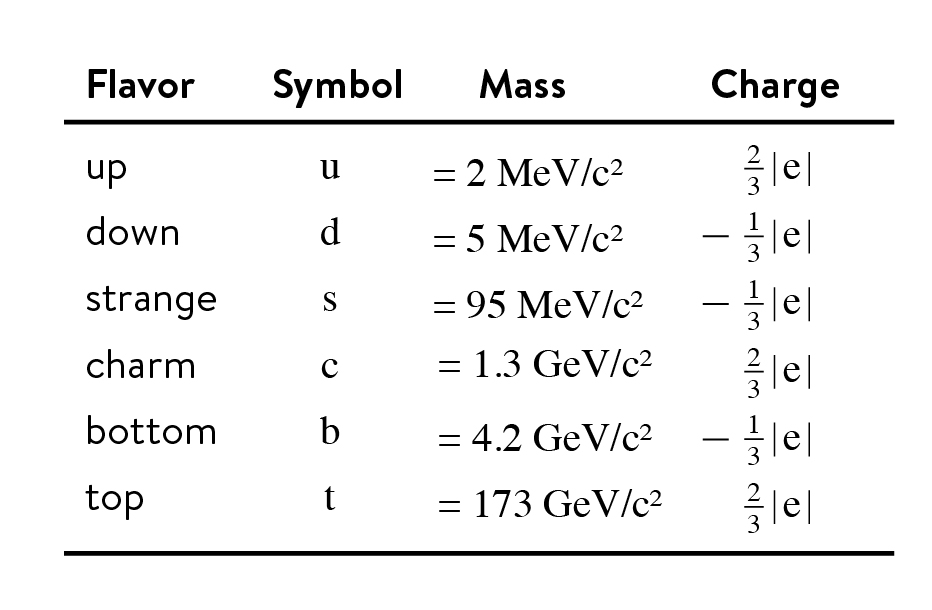
Table 2 Flavor, symbol, mass and charge for Quarks. (Gasiorowicz, 2005
4.2 Baryons: the bound states of quarks
As Quarks have never been seen isolated (i.e there hasn’t been any reproducible experiment that yields temperatures high enough to see an isolated quark), they are always seen as Bound-states, which form hadrons and subsequently, Baryons. Baryons are “color-singlet bound states of three quarks” with half-integer spin (Srednicki, 2007, p. 503), and that can be classified as types of Hadrons. This means, that Baryons are all sub-atomic particles that are made up of three or more quarks and that are color invariant, i.e. they do not have any color quantum number as quarks do. Baryons instead have their own quantum number (Baryon number) and are also associated with strangeness, both of which are conserved through every interaction, as Gasiorowicz describes: “there is clear evidence for baryon conservation: The number of baryons minus the number of antibaryons is constant in any interaction” (Gasiorowicz, 2005, p.1). As classified as fermions, Baryons follow Fermi-Dirac statistics models, and obey the Pauli exclusion principle, under which two identical particles with half-integer spins cannot occupy the same quantum state. The most common example of Baryons is the proton and the neutron, which have charge +1 and 0 correspondingly and compose the nucleus of atoms. Other Baryons that could be formed as bound-states of quarks are Lambda and Omega, although they are not very common particles in nature.
As Baryons are made up of three quarks, they are considered to be “bound-states” of quarks, as Yaffe defines, “Bound states produced by the strong interactions are called hadrons (…) only certain types of bound states of quarks can exist, namely those which are ´colorless´.” (Yaffe, 2012). This bound state is produced by the exchange of gluons between quarks in the strong nuclear force, although this interaction is more thoroughly explained in the theory of Quantum Chromodynamics (QCD) where color charge is conserved in quarks and gluons to produce color neutral particles. This theory, however, will not be further discussed in this paper. A common representation of protons and neutrons as bound states of quarks is shown below, where the charge and spin of the quarks is conserved in their interaction.

Figure 3: representation of a proton and a neutron as bound-states of quarks.
5. Leptons: the other common particles in the universe
5.1 Quarks: never lonely but always bonding
Leptons are the other type of fermions in the standard model that make the building blocks of matter and in contrast to the quarks, the leptons do not interact with the strong nuclear force. According to Srednicki (2007), “Leptons are spin-one-half particles that are singlets of the color group”. This means, that that leptons, as opposed to quarks, are color singlets, i.e. that they are invariant under color transformations and by so, they do not have color quantum numbers. The six different types of leptons are “naturally grouped into three families or generations: e and νe, μ and νμ, τ and ντ” (Srednicki, 2007. p. 532), and in accordance with the predictions of relativistic quantum mechanics, each one of them is supposed to have corresponding anti-particles (Gasiorowicz, 2005). In addition to that, “associated with each generation of leptons is a conserved quantum number called a lepton number. (…) They are zero for all particles other than leptons, such as photons, protons, or neutrons, and for multiparticle states the lepton numbers of the individual particles are simply added” (Martin, Shaw. 2003, p. 623). A table of the conserved lepton numbers for each lepton is shown below, where each is constant in strong and electromagnetic interactions.

Table 3: Table of lepton number values for Muon, Tau, Electron and their corresponding neutrinos. Source: HEP Group Research.
The muon and Tau can be considered as heavier and more unstable versions of the electron, having heavier masses, while neutrinos in the other hand are considered to be almost mass-less ghostly particles for their unique behavior. The electron, muon and tau have –1 electric charge, and are represented by a Dirac field, while the three neutrino flavors are neutrally charged and are represented by Majorana or left-handed Weyl fields.
The Muon beta decay, in which the lepton number is conserved is given by the following:
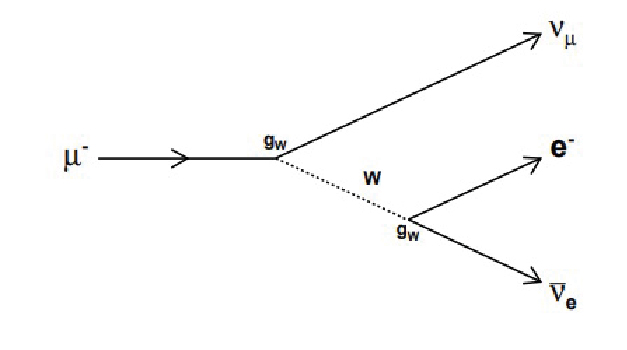
Figure 4: Feynman diagram of Muon Decay. Source: HEP Group Research.
The Tau decay is then given by the following:

Figure 5: Feynman diagram of the Tau Decay, in which a Tauonic Neutrino is produced. Source: HEP Group Research.
The Tau decay is then given by the following:

Figure 6: The beta decay is given by the fermi four-fermion coupling as shown in the following:
6. Neutrinos: the ghostly particles of the universe
Neutrinos are amongst many phenomena, one of the most delightful and intriguing modern-discoveries of particle physics – and one could even say – of general physics. The existence of the Neutrino was first postulated by Wolfgang Pauli in 1930, in a now rather-famous letter he addressed to his physicist colleagues at a symposium in Tubinga. Within it, Pauli expressed his concerns over an anomaly he noticed during beta-disintegration processes: the energy and momentum in the decay was not conserved at all, thus, there must exist an unknown weak-interacting particle with no charge that took away part of the energy and the momentum. Nowadays, we call it Neutrino, and although modern technology has allowed us to further exploit the properties of this subatomic particle, the new-findings have left the scientific world with rather more open-questions than reasonable answers, as it succeeds in proving the theory and the calculations wrong. (Hernandez, 2010)
What is it about neutrinos that makes them possibly the most intriguing particle and maybe the key to understanding our very own origin? Neutrinos are the only particles in the universe that oscillate freely (i.e they change spontaneously their flavor), carry no conserved charge, have masses almost close to zero (but nevertheless they have non-zero masses), are known to only be left-handed (with no right-handed neutrinos yet observed) and they do not acquire their mass through the Higgs field, but rather from a yet unknown source. Neutrinos belong to the family of leptons, so they interact only with the weak force, and there exist three types or flavors of neutrinos: the muon neutrino, the tau neutrino and the electron neutrino. As neutrinos travel through space and time, they change or “oscillate” their flavor, which until recent experiments, was thought to be an erratic behavior. Additionally, Neutrinos are particular in chirality, a quantum mechanical phenomenon in subatomic particles, under which almost all particles are right-handed and left-handed, but neutrinos, being the exception, have only been observed in their left-handed versions and no right-handed neutrino has been found. Their particular nature makes them extraordinarily difficult to measure, as they interact with almost nothing, and modern experiments that aim to measure the properties of these particles are often far too complex. What makes these particles intriguing indeed, is the incognita around its mass (where do they acquire it? How do they acquire it? Is it related to new particles and forces yet to be discovered?), and the abnormality found around its oscillations.
Nowadays, by theory we know that each type of neutrino is a mass state, and that each flavor is merely a quantum superposition of the three matter-states. What we don’t know, for sure, is either how each of these states acquires its mass, or why neutrinos work this way.
DISCUSSION
The theory of the SM dictates that neutrinos should be massless, property that was believed to be true until experiments started to shed light on the nature of neutrinos. Reines and Cowan first discovered the existence of the neutrino in 1956, when they studied the emissions of a nuclear reactor near the Savanah river. Later, in 1968 Raymond Davis Jr. developed the Homestake experiment in South Dakota: a water tank filled with Chlorine-37, under which when a neutrino interacted with a chlorine atom, it produced a radioactive argon isotope which could then be measured. This first experimental measurement allowed physicists to compare the amount of neutrinos the theory predicted that arrived to earth and the actual amount of neutrinos that were arriving. This gave hint to what was known as the solar neutrino problem. The super-Kamiokande experiment (the successor of the Kamiokande experiment in Japan) confirmed the major problem: there was only arriving a fraction of the neutrinos to the earth than the amount that theory predicted. The super-Kamiokande worked with a Cherenkov-radiation detector, which was produced when a neutrino interacted with water atoms and produced heavily-charged particles, and in 1998 succeeded in describing a hypothesized theory: neutrinos of one type were oscillating to neutrinos of other type. Such discovery challenged the theory of the SM, as to the moment neutrinos were supposed to be massless, but if they oscillate freely between flavors, they need to have mass. (Fukuda, 1994) (Fukuda, 1996) (Fukuda, 2001) (Wilkes, 2000).
But it wasn’t until 2002, when the SNO experiment, in Sudbury (Ahmad, 2001) (Ahmad, 2002), demonstrated that solar neutrinos (neutrinos that were produced in the internal nuclear reactions of the sun) change their flavor in their path through earth. The massive detector worked with 1000 tons of heavy water (in the form of deuterium, as each hydrogen atom possess an additional neutron) and Cherenkov-radiation detectors. The experiment successfully demonstrated that the deficit of neutrinos that were arriving to the earth wasn’t due to imprecise measurements, but rather to the fact that they were all designed to only measure one flavor of neutrino, at certain energy levels.
The discovery of neutrino oscillations solved the solar-neutrino problem, but it only left physicists with more open questions, as it demonstrated that the theory and mathematical calculations – that everyone believed to be true – do not coincide with the experimental evidence (Krupke, 2007) (Formaggio, 2021). This leaves multiple open questions, regarding the Standard Model and its validity, suggesting that the theory we possess doesn’t accommodate to the complexity of the neutrino, and that it should be expanded to include the new-found experimental evidence. Such expansion, as physicists believe, should consider the modern-neutrino dilemma: if neutrinos are Majorana masses and if they work by the seesaw mechanism.

Such theory predicts the existence of right-handed neutrinos – extremely heavy counterparts of the light neutrinos we already know and that are believed to be the antineutrino itself- that only interact with gravity and no other fundamental force. These particles, as the light left-handed neutrinos, don´t acquire their mass from the Higgs field, as they have no electric charge that accounts for an interaction with the Higgs field. The mass of the left-handed neutrino is then justified by its interaction with its right-handed counterpart in what is described as the see-saw mechanism. In this interaction, the extremely heavy right-handed neutrinos endow the left-handed neutrinos of extremely tiny masses. The existence of this particle would mean, by the theory proposed in the see-saw mechanism, that neutrinos are their own anti-particles, and by so, classified as a Majorana particle. If proved experimentally, that neutrinos are their own antiparticles, the new-findings could shed light on the disparity of matter and anti-matter in the universe, and provide answers on many of the theories beyond the standard model.
Other theories, like Supersymmetry and String theory, rise as alternate models to the SM that aim to better describe subatomic particles and their interaction within the universe. Supersymmetry (SUSY) for an instance, is a space-time symmetry that links bosons and fermions together, and proposes in what is called the minimal supersymmetry standard model (MSSM) that each subatomic particle has a corresponding “Super-partner” with spin half a unit different. These super-partners share same mass and conserve most of their quantum numbers. Proving supersymmetry correct would shed light on how neutrinos acquire their mass and on neutrino mixing. (Mukhopadhyay, 2003)
String theory, on the other side, is a theory developed in the late 60´s, which in general and simplistic terms, proposes that every particle behaves like a closed vibrating string that moves along space and time, rather than a wave-like behavior or a point-wise behavior. String theory results interesting not only for the multiple mathematical structures it proposes and the complex beauty between topology and geometry that is embedded within them, but because it proposes a unification of all the fundamental forces, including the complex unification of gravity with the quantum world. At simple-sight, string theory seems the perfect theory to explain the mass of neutrinos and many beyond-the standard model theories, however, its major constraint relies on one of its mathematical foundations.
In order for string theory to work, and for many of the mathematical structures it proposes to work accordingly to the behavior of particles, requires the existence of 26 dimensions for its space-time, and about only 11 dimensions for it to work accordingly to supersymmetric theories. (Wray, 2011) (Mariño, 2015).

CONCLUSIONS
While physicists strive to develop more advanced technologies that will allow to better study neutrinos and the gaps of knowledge we have on the universe, we´ll remain with the limited knowledge we already have until experimental proof can be provided. In physics, as it happens, while theory and mathematical proofs validate for the veracity of many theories, only experimental evidence is considered for a complete acceptance of these. Likewise, until experimental evidence is given on the matter of theories like supersymmetry and string theory, we´re left to nothing but to accept the incomplete and inconsistent SM that until recent years’ physicists trustily believed in. Such advancements are however, held back by the experimental limitations found in our current technology: first of all, the experiments to carry out would require vast levels of energy (which we haven´t been able to produce yet) so as to recreate the optimal conditions, immense facilities, and technology not yet invented. Exploiting these aspects in the future may even allow physicists to observe phenomena in the multiple dimensions that theories like string theory and supersymmetry propose. The theory yet, results even far from reality, as it too has its constraints. Unveiling the mystery behind neutrinos and their mass, the possibility of another fundamental force and many theories behind the standard model that aim towards a grand unified theory of everything remain until now mostly an engineering problem. At least, until any other significant revolutionary theory that explains and models the interactions between elementary particles and the universe is proposed.
Shedding light on any of these gaps and open questions we have in the universe will provide significant advancements in several areas, and on the current understanding we have of the world and our origins. And while knowledge around particle physics has progressed severely since its beginnings, we´re no more stagnant than we were decades ago. Will we get to solve all these open questions someday? Or will we be left with inconclusive and rudimentary knowledge of the universe we endlessly live in?
REFERENCES
Aker, M., Beglarian, A., Behrens, J., Berlev, A., Besserer, U., Bieringer, B., … Collaboration, T. K. (2022). Direct neutrino-mass measurement with sub-electronvolt sensitivity. Nature Physics, 18, 160–166. doi:10.1038/s41567-021-01463-1
Ahmad, Q. R., Allen, R. C., Andersen, T. C., D.Anglin, J., Barton, J. C., Beier, E. W., … Yeh, M. (2002). Direct Evidence for Neutrino Flavor Transformation from Neutral-Current Interactions in the Sudbury Neutrino Observatory. Phys. Rev. Lett., 89, 011301. doi:10.1103/PhysRevLett.89.011301
Bietenholz, W. (2020). What are Elementary Particles? From Dark Energy to Quantum Field Excitations. 2011.07719
Bilenky, S. M. (2 2001). Neutrinos. Physical Science and Technology, 395–417.
Boyle, L., Finn, K., & Turok, N. (2022). The Big Bang, CPT, and neutrino dark matter. Annals of Physics, 438, 168767. doi:10.1016/j.aop.2022.168767
Cabaret, D. M., Grandou, T., Grange, G. M., & Perrier, E. (2021). Elementary particles: What are they? Substances, elements and primary matter. Foundations of Science 2022. doi:10.48550/arXiv.2103.05522
Choubey, S. (2017). Neutrino oscillations. Current Science, 112, 1381–1384. Retrieved from http://www.jstor.org/stable/24912683
Collaboration, S.-K., Fukuda, Y., Hayakawa, T., Ichihara, E., Inoue, K., Ishihara, K., … Young, K. K. (8 1998). Evidence for Oscillation of Atmospheric Neutrinos. Physical Review Letters, 81, 1562–1567. doi:10.1103/PhysRevLett.81.1562
Cottingham, W. N., & Greenwood, D. A. (2007). An Introduction to the Standard Model of Particle Physics (2nd ed.). doi:10.1017/CBO9780511791406
Council, N. R. (2003). Neutrinos and Beyond: New Windows on Nature. doi:10.17226/10583
Ellis, J. (1991). Beyond the Standard Model at LEP. Philosophical Transactions: Physical Sciences and Engineering, 336, 247–259. Retrieved from http://www.jstor.org/stable/53787
Y. Fukuda et al., Phys. Rev. Lett. 77 (1996) 1683.
S. Fukuda et al., Phys. Rev. Lett. 86 (2001) 5651 and 5656; Phys. Lett. B539 (2002) 179; M.B. Smy et al., Phys. Rev. D69 (2004) 011104
Y. Fukuda et al., Phys. Lett. B335 (1994) 237
Formaggio, J. A., de Gouvêa, A. L. C., & Robertson, R. G. H. (2021). Direct measurements of neutrino mass. Physics Reports, 914, 1–54. doi:10.1016/j.physrep.2021.02.002
Frenk, C. S., Kalmus, G. E., Smith, N. J. T., White, S. D. M., & Wark, D. L. (2003). Neutrino mass measurements. Philosophical Transactions of the Royal Society of London. Series A: Mathematical, Physical and Engineering Sciences, 361, 2527–2551. doi:10.1098/rsta.2003.129
Gasiorowicz, S. G., & Langacker, P. (2005). ELEMENTARY PARTICLES IN PHYSICS 1 Elementary Particles in Physics. Philosophical Transactions of the Royal Society of London. Series A: Mathematical, Physical and Engineering Sciences, 361, 2527–2551. doi:10.1098/rsta.2003.1291
Grotz, K., & Klapdor-Kleingrothaus, H. (1 2018). The Glashow–Weinberg–Salam Theory of The Electroweak Interaction (pp. 200–243). doi:10.1201/9781351077248-6
Hernandez, P. (10 2010). Neutrino physics. CERN Yellow Report CERN-2010-001, 229–278. doi:10.48550/arXiv.1010.4131
Kane, G. (2017). Modern Elementary Particle Physics: Explaining and Extending the Standard Model (2nd ed.). doi:10.1017/9781316691434
Kruppke, D. (2007). On Theories of Neutrino Oscillations: A Summary and Characterisation of the Problematic Aspects. (Bielefeld U.)
Mann, R. (2010). Introduction and overview (pp. 1–20). CRC Press. ISBN 978-1-4200-8298-2
Mariño, M. (2015) Mathematics and string theory. Département de physique théorique et section de Mathématiques. Université de Genève, Switzerland. Published in: La matematica, vol. IV: pensare il mondo. Einaudi.
Marsh, G. (2018). An introduction to the Standard Model of Particle Physics for the non-specialist. World Scientific. ISBN 978-981-3232-58-7
Martin, B., & Shaw, G. (2001). Particle physics, Elementary (Encyclopedia of physical science and technology. Third Edition, pp. 617–648; R. A. Meyers, Ed.). Academic Press. ISBN 978-0-12-227410-7
Ahmad, Q. R., Allen, R. C., Andersen, T. C., Anglin, J. D., Bühler, G., Barton, J. C., … Yeh, M. (2001). Measurement of the Rate of νe+d→p+p+e− Produced by ^8B$ Solar Neutrinos at the Sudbury Neutrino Observatory. Phys. Rev. Lett., 87, 071301. doi:10.1103/PhysRevLett.87.071301
Martin, B. R., & Shaw, G. (2008). Particle Physics (Third Edition; F. K. Loebinger, F. Mandl, & D. J. Sandiford, Eds.). Wiley.
Morrison, J. (2020). Particle Physics (Second Edition). Academic Press, London.
Mukhopadhyaya, B. (2003) Supersymmetry and neutrino mass. Harish-Chandra Research Institute, India. Proc Indian Natn Sci Acad, 70, A No.1, January 2004, pp.239–249.
Null, N., Aaltonen, T., Amerio, S., Amidei, D., Anastassov, A., Annovi, A., … Zucchelli, S. (2022). High-precision measurement of the W boson mass with the CDF II detector. Science, Vol. 376, pp. 170–176. doi:10.1126/science.abk1781
Q. R. Ahmad et al. (SNO), Phys. Rev. Lett. 87, 071301 (2001), [arXiv:nucl-ex/0106015].
Q. R. Ahmad et al. (SNO), Phys. Rev. Lett. 89, 011301 (2002), [arXiv:nucl-ex/0204008].
Rajasekaran, G. (2014). Fermi and the theory of weak interactions. Resonance, 19, 18–44. doi:10.1007/s12045-014-0005-2
Reucroft, S., & Williams, E. (2 2019). The Structure and Properties of Elementary Particles.
Robson, B. (2012). The Generation Model of Particle Physics (pp. 1–29; E. Kennedy, Ed.). doi:10.5772/35071
Srednicki, M. (2007). Quantum field theory. University of California.
Suzuki, Y. (1999). Solar neutrino results from Super-Kamiokande. Nuclear Physics B – Proceedings Supplements, 77(1), 35–42. doi:10.1016/S0920-5632(99)00393-X.
Suzuki, Y. (2019). The Super-Kamiokande experiment. The European Physical Journal C, 79, 298. doi:10.1140/epjc/s10052-019-6796-2
Takhistov, V. (2020). Review of Atmospheric Neutrino Results from Super-Kamiokande. For the Super-Kamiokande Collaboration. Prague, Czech Republic. https://doi.org/10.48550/arXiv.2012.06864.
Virdee, T. S. (2016). Beyond the standard model of particle physics. Philosophical Transactions of the Royal Society A: Mathematical, Physical and Engineering Sciences, 374, 20150259. doi:10.1098/rsta.2015.0259
Walliman, D. (2021, May 1) The map of particle physics / The Standard Model Explained. [Video]. Domain of Science.
Weinheimer, C. (2006). DIRECT NEUTRINO MASS MEASUREMENTS. International Journal of Modern Physics A, 21(08n09), 1875–1886. doi:10.1142/S0217751X06032836
Weinheimer, C. Zuber, K. (2013). Neutrino masses. Annalen der Physik, 525(8-9), 565–575.
C. Weinheimer (2015) Direct Search for the Neutrino Mass and the KATRIN experiment. University of Muenster, Institut fuer Kernphysik
Weinberg, S. (1967). A Model of Leptons. Physical Review Letters, 19, 1264–1266. doi:10.1103/PhysRevLett.19.1264
Wilczek, F. (11 2001). Unified Field Theories. Physical Science and Technology, 19, 339–349. doi:10.1103/PhysRevLett.19.1264
Wilkes, R. J. (2000). Results on neutrino oscillations from Super-Kamiokande. Advances in Space Research, 26, 1813–1822. doi:10.1016/S0273-1177(99)01228-4
Wray, K. (2011) An introduction to string theory. Berkeley University.
Xin, X. (2007). Glashow-Weinberg-Salam Model: An Example of Electroweak Symmetry Breaking
Laurence, G. Y. (2012). Particles and Symmetries. University of Washington.
Zyla, P. Others. (2020) Review of particle physics. PTEP, volume 20, issue 8. doi: 10.1093/ptep/ptaa104.