
Development of a Cessna 152 model for the x-plane flight simulator
- Estudiante Gimnasio Campestre
- Profesor del Gimnasio Campestre
Correspondencia para los autores:
jzambrano@campestre.edu.co
Recibido: 15 de octubre de 2025
Aceptado: 5 de noviembre de 2025
Table of Contents
ABSTRACT
This study presents the development of a highfidelity freeware Cessna 152 model for the XPlane flight simulator, aimed at enhancing virtual pilot training. Employing the Engineering Design Process, the project integrates real-world technical documentation, aerodynamic simulations via XFLR5, and iterative testing within X-Plane. Custom airfoil data, along with detailed 3D modeling and texturing techniques were implemented to optimize performance and realism. Additionally, incorporating custom scripting via XTLua and FMOD-based sound design improved system behavior and auditory feedback. The model demonstrated significant improvements over existing freeware options in visual, performance, and functional aspects, as evidenced by high download rates and positive user feedback. This research confirms that open-source development can effectively bridge gaps in accessible training tools for aviation students and enthusiasts, while contributing to the broader advancement of open-source software development.
Keywords: Flight Simulation, Cessna 152, Engineering Design Process, Freeware, Open-Source, Software Development.
RESUMEN
Este estudio presenta el desarrollo de un modelo freeware de alta fidelidad del Cessna 152 para el simulador de vuelo X-Plane, con el objetivo de mejorar el entrenamiento virtual de pilotos. Empleando el Proceso de Diseño de Ingeniería, el proyecto integró documentación técnica, simulaciones aerodinámicas a través de XFLR5 y pruebas iterativas en X-Plane. Se utilizaron datos personalizados de perfiles alares y técnicas detalladas de modelado y texturizado en 3D para mejorar el rendimiento y el realismo, y se hizo uso de scripts personalizadas con XTLua y diseño de sonido basado en FMOD para mejorar el comportamiento del sistema y la retroalimentación auditiva. El modelo mostró mejoras significativas con respecto a las opciones gratuitas existentes en aspectos visuales, de rendimiento y funcionales, como lo demuestran las altas tasas de descarga y las críticas positivas de usuarios. Esta investigación confirma que el desarrollo de código abierto puede cerrar eficazmente brechas en las herramientas de formación accesibles para estudiantes y entusiastas de la aviación, al tiempo que contribuye al avance más amplio del desarrollo de software de código abierto.
Palabras clave: Simulación de Vuelo, Cessna 152, Proceso de Diseño de Ingeniería, Freeware, Código Abierto, Desarrollo De Software.
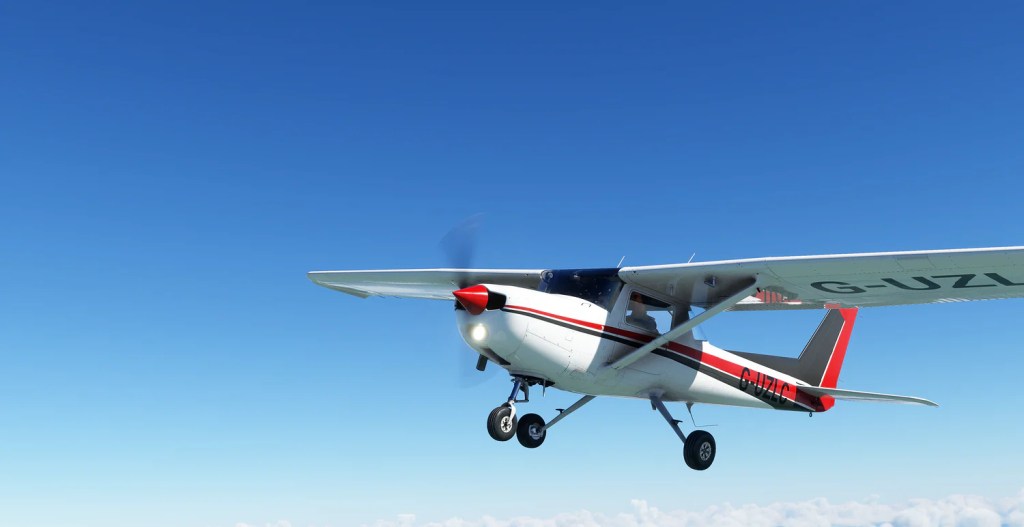
The increasing integration of flight simulators into pilot training programs highlights the need for highly realistic and accessible simulation models.
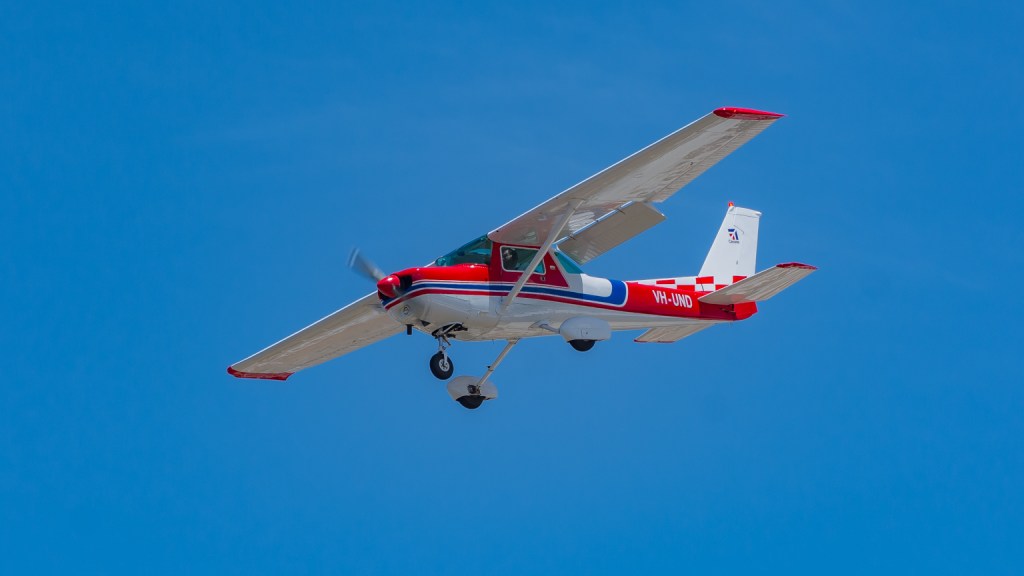
Fotografía: Sid Mitchell 2015
INTRODUCTION
The increasing integration of flight simulators into pilot training programs highlights the need for highly realistic and accessible simulation models. Despite the prevalence of commercial payware options, a significant gap remains in the availability of freeware models that accurately replicate training aircraft, particularly the Cessna 152. Introduced in the early 1970s, the C152, a small, single-engine, two-seat general aviation aircraft, that is widely used for flight training as well as personal and recreational flying, which was not well represented in any freeware model for XPlane. This study addresses this gap by developing an open-source Cessna 152 model designed to meet rigorous training requirements.
Previous work in flight simulation has often focused on commercial products with limited accessibility for students and enthusiasts. Prior freeware models typically lack the level of detail required for effective training, particularly in terms of aerodynamic fidelity and system functionality. This research builds upon established aerodynamic theories and the Engineering Design Process to create a realistic and accessible simulation tool.
The primary objective of this study is to model the physical behavior, aerodynamic performance, and system operations of the Cessna 152 using advanced computational tools and iterative design methodologies. By combining technical documentation, computational simulations, and user feedback, the proposed model offers a comprehensive solution that enhances the educational and recreational potential of flight simulation.
REFERENCE FRAMEWORK
Flight simulators serve as indispensable tools in modern aviation, effectively bridging the gap between virtual and real-world flying. Programs like X-Plane excel in procedural training, particularly when it comes to replicating real-world instrument navigation, including VOR, NDB, and even ILS procedures. Such simulators allow pilots to immerse themselves in near-realistic environments and practice critical cockpit skills without the risk associated with actual flight.
Moreover, these platforms offer significant enhancements in the area of instrument training and realism. Precision approach procedures, such as ILS CAT I, II, and III, as well as RNP, can be rigorously practiced. Pilots are able to master advanced maneuvers like holding patterns, radial interceptions, and follow established STAR and SID simulations with accuracy. They can also implement Performance-Based Navigation (PBN), which adds another layer of sophistication and realism to their simulated experiences.
Online multiplayer training environments further elevate the authenticity of flight simulation. Networks like VATSIM, IVAO, and PilotEdge foster realistic air traffic control communications, challenging pilots to develop and refine their radio telephony skills in busy aerodrome traffic interactions. By incorporating a human element —both pilots and controllers—, these networks replicate real operational scenarios where situational awareness and precise communication become critical.
Additionally, simulators play a key role in emergency and failure training. By allowing simulated system failures—ranging from hydraulic and electrical issues to instrument malfunctions—pilots can hone their decision making processes and practice scenariobased responses to potential bird strikes, engine failures, and other emergencies. This form of risk-free training ensures that pilots are better prepared to handle unforeseen challenges in an actual flight.
Finally, flight simulators significantly enhance pilot situational awareness using orthophotos and satellite imagery, which provide precise geographical realism. Weather simulations introduce winds, turbulence, and icing conditions, enabling pilots to practice diverse weather scenarios. These comprehensive features create a multi-dimensional environment where both novice and experienced aviators can sharpen their skills, expand their knowledge, and become more adept and confident in real-world flying operations.
Furthermore, the theoretical and practical underpinnings of flight simulation are supported by an in-depth understanding of physics, aerodynamics, and aircraft design, as outlined below.
2.1. Physics
2.1.1. Aerodynamic principles and flight dynamics
The aerodynamic principles and flight dynamics refer to the theoretical background that makes flight possible. Essentially, these are all factors that have a direct effect on flight performance. Understanding these principles allows the model to respond accurately to various flying conditions and pilot inputs.
To carry out a thorough analysis of all components acting on the aircraft it is necessary to understand forces. The behavior of the airframe depends on four (4) main physical variables; namely, lift, weight, thrust, and drag.
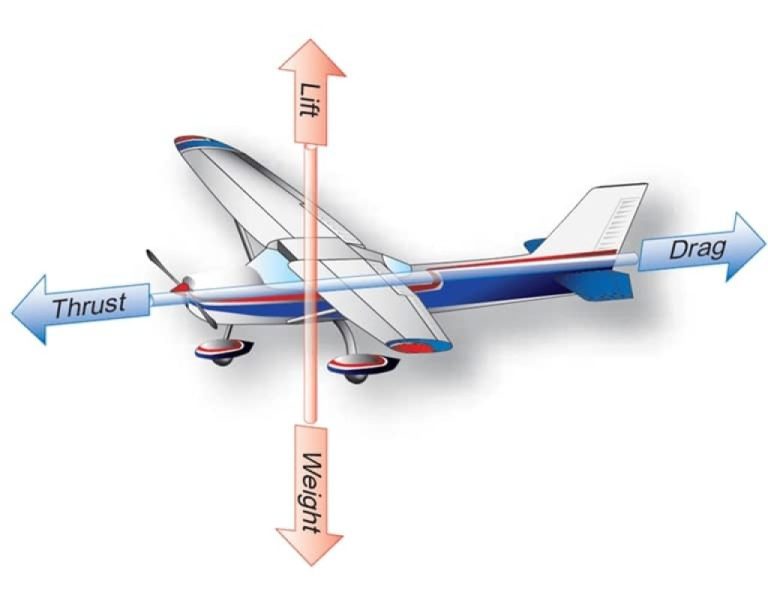
Figure 1. Forces on an aircraft
Lift is generated primarily by the wing’s shape and angle of attack, and it is the force that opposes weight, responding dynamically to changes in airspeed, angle of attack, and wing configuration (e.g., with or without flaps), and it also varies with altitude due to changes in air density. Weight is centered on the force due to gravity and directly influences stability and maneuverability. Modeling weight distribution is essential for capturing accurate responses to maneuvers and assessing potential load induced impacts on flight performance. Thrust is a mechanical force generated most often through the reaction of accelerating a mass of gas. Since thrust is a force, it is a vector quantity having both a magnitude and a direction (NASA, Glenn Research Center, 2022). Finally, drag is defined as the force that opposes thrust. Drag is divided into parasite drag (from skin friction and form drag) and induced drag (from lift production). Modeling drag accurately involves calculating the total drag coefficient and understanding how different wing profile configurations affect drag at various speeds.
2.1.2. Wing shape and profile.
To fully assess an aircraft’s aerodynamic behavior, it is crucial to analyze the key elements influencing its performance. Among these, four (4) primary factors play a significant role: wing geometry, laminar flow, angle of incidence, and chord line and aerodynamic center.
Wing geometry determines key aerodynamic characteristics, including lift generation, stall behavior, and overall efficiency. Parameters such as aspect ratio (the ratio of wingspan to chord length) and airfoil shape dictate how efficiently the aircraft produces lift and how it responds to different flight conditions. For example, the Cessna 152 features a lowaspect- ratio wing with specific airfoil profiles designed to enhance low-speed stability, which is crucial for flight training. A higher aspect ratio, typically seen in gliders, reduces induced drag and improves lift-to-drag ratio, while lower aspect ratios enhance maneuverability but increase drag.
Laminar flow plays a critical role in minimizing aerodynamic resistance. It refers to the smooth, uninterrupted flow of air over the wing surface, which reduces skin friction drag and enhances efficiency. However, as airflow moves along the wing, it can transition into turbulent flow, increasing drag and reducing aerodynamic performance. The shape of the wing, surface finish, and operational speed all influence whether laminar flow is maintained or disrupted. Aircraft designed for high efficiency often incorporate features like laminar-flow airfoils and smooth wing surfaces to delay turbulence and optimize performance.

Figure 2. Wing Geometry Definitions. NASA. Glenn Research Center.
The angle of incidence, or the fixed angle at which the wing is attached to the fuselage, significantly affects flight characteristics. This angle determines how much lift the wing generates at a given speed and attitude. A higher angle of incidence can improve takeoff and landing performance by allowing the aircraft to generate lift at lower speeds, but excessive incidence can increase drag during cruise flight. This parameter is carefully selected based on the aircraft’s intended operational envelope to balance performance, efficiency, and control.
Finally, the chord line and aerodynamic center are essential for stability and maneuverability. The chord line is an imaginary straight line connecting the leading and trailing edges of the wing, serving as a reference for measuring the angle of attack. The aerodynamic center is the point along the chord line where changes in lift occur without altering the pitching moment, making it a crucial factor in stability analysis. Accurate understanding and modeling of these elements ensure that an aircraft maintains predictable handling characteristics, stable flight dynamics, and efficient aerodynamic performance across different phases of flight.
2.1.3. Fuselage Anatomy and Flight Controls
Fuselage anatomy is fundamental to an aircraft’s aerodynamic performance and stability. The structural materials selected for the fuselage affect key attributes such as weight, durability, and drag. Analyzing these materials is crucial for understanding their impact on overall efficiency and the aircraft’s structural integrity. Equally important is the placement of the wings and tailplane, which directly influences the center of gravity and stability.
In the Cessna 152, a high-wing configuration not only improves visibility but also enhances stability, while the tailplane’s position and size are essential for ensuring proper longitudinal balance and effective elevator response, both which are critical factors for precise pitch control and in-flight trim adjustments. Moreover, the streamlining of the fuselage contributes to reducing drag, thereby optimizing performance at various speeds. Finally, flight controls, including ailerons, elevators, rudder, and flaps, are designed to modify the airfoil in response to user inputs, ensuring that the aircraft responds accurately and consistently to pilot commands.
2.2. X-Plane Blade Element Theory (BET) simulation
X-Plane’s Blade Element Theory (BET) provides the foundation for real-time aerodynamic calculations within the simulator. Unlike traditional flight models that rely on precompiled aerodynamic data tables or simplified equations of motion, BET breaks down the aircraft into numerous small “blade elements,” each treated as a distinct airfoil section. By computing the aerodynamic forces acting on these elements, then summing and integrating their contributions, X-Plane can generate a highly dynamic and detailed simulation of an aircraft’s flight behavior.
At the core of BET lies Newton’s Second Law of Motion, which states that the net force acting on an object equals its mass times its acceleration. In the context of flight simulation, each blade element experiences local airflow conditions (airspeed, angle of attack, and kinematic viscosity, among others), producing a small amount of lift and drag that contributes to the aircraft’s overall aerodynamic forces. The result is a system where each blade element determines its local Angle of attack (AoA) based on the aircraft’s pitch, roll, yaw, and instantaneous flight conditions (e.g., gusts, slips, or sideslips). By applying known aerodynamic coefficients (lift and drag coefficients from airfoil data) to each element’s surface area, the simulator calculates forces acting in the normal (lift) and tangential (drag) directions. Summing all the elemental forces around the aircraft yields the total aerodynamic force and pitching, rolling, andyawing moments acting on the airframe.
BET can be viewed as a discrete approximation of aerodynamic integrals across the wing and fuselage surfaces, where the aircraft’s geometry (wings, control surfaces, fuselage sections) is segmented into multiple panels or blade elements. Each panel references the lift and drag polars of the relevant airfoil section for its instantaneous AoA. These polars are typically derived from wind tunnel data or computational fluidd ynamics (CFD) analyses. The Force Computations are given by

where 𝐿i and 𝐷i denote the lift and drag forces generated by element 𝑖 (respectively), 𝜌 is the local air density, 𝑉i the local velocity, 𝑆i the surface area of the element, and 𝐶Li! and 𝐶Di the lift and drag coefficients from airfoil data (respectively).
Summing over 𝑛 blade elements, we obtain

The net aerodynamic forces and moments are then applied to the aircraft’s center of gravity, influencing its translational and rotational accelerations.
2.3. Operational Characteristics
Operational characteristics are defined by the aircraft’s performance, limitations, and weightand balance considerations. Performance metrics are drawn from manufacturer data and the Cessna 152’s Pilot Operating Handbook, detailing fuel efficiency, climb rates, and range under diverse scenarios. These parameters enable precise configuration within the simulator, ensuring that the virtual model closely mirrors real-world behavior. The model also delineates operational limits by clearly defining maximum speed (Vne), stall speed (Vs), and maximum takeoff weight (MTOW), thereby establishing a safe operating envelope for various flight conditions.
Additionally, as weight and balance are critical for optimizing in-flight efficiency and stability, the payload distribution is carefully calibrated based on the aircraft’s default zero fuel weight (ZFW) and center of gravity. This calibration also adapts dynamically as fuel is consumed, maintaining realistic performance throughout the flight envelope.
2.4. Visuals
The visual development of the Cessna 152 model encompasses several key aspects, starting with 3D modeling. This process involves the arrangement of digital and vectorized polygons within a three dimensional space, where points are connected to form lines, lines define faces, and faces create complete objects. In essence, 3D modeling translates geometric data into a tangible virtual representation of the aircraft.

3D blueprint of the Cessna model
Animations play a critical role in bringing these static 3D models to life. In the open-source suite Blender, the animation process involves several steps. Designers use the timeline to create sequences with keyframes that record important changes in properties such as position, rotation, and scale. Parts of the aircraft – such as flaps, landing gear, and control surfaces – are rigged with defined pivot points to ensure realistic movements. Keyframes serve as specific points in time where the state of an object is recorded, and interpolating between these keyframes generates smooth transitions. Additionally, datarefs are integrated to link animations with the aircraft’s operational parameters, ensuring that movements, such as flap deflections, are synchronized with changes in speed or altitude. The animation phase is iterative, with ongoing adjustments to keyframe density, pivot points, and dataref mappings to balance visual realism and simulation performance.
Resource optimization is also a fundamental aspect of the visual development process. Through extensive trial and error, the project assessed in-simulation PC performance as a function of various model modifications, such as polygon count. Comparisons with similar projects guided optimizations to achieve a high-quality model that runs efficiently on a range of hardware.
The development process relied heavily on specialized software tools. The Cessna 152 model was fully developed using Blender, an open-source 3D modeling and animation software. Documentation played a significant role, with extensive references gathered regarding the aircraft’s geometry, dimensions, and curves from manufacturer photos, videos, and diagrams. Tutorial content, including guides, manuals, and community forum discussions, provided additional insights and techniques in 3D modeling.
Central to the visual integration is the X-Plane object (.obj) format, a proprietary, plain-text specification used to define 3D objects for the X-Plane flight simulator. This format uses command-based lines—each beginning with a keyword such as OBJECT, VT, TRIS, or QUADS—to instruct the simulator on how to construct the aircraft’s geometry, apply textures, assign material properties, and manage animations. The file structure is organized as a sequential list of text commands that define vertices, polygonal faces, and surface attributes. The hierarchy within a .obj file facilitates modular design, allowing for the integration of complex assemblies like engines and control surfaces. Furthermore, the format incorporates additional elements for texture mapping, material properties, and even collision detection, thereby providing not only the visual outline but also essential simulation data.
The .obj format serves several functions. It defines the precise 3D geometry of the aircraft, maps textures and material properties to surfaces for realistic rendering under varied lighting conditions, and controls animations by specifying pivot points and transformation parameters. It also aids in performance optimization, as the modular structure allows for adjustments in polygon count or the application of Level-of-Detail (LOD) techniques. Beyond visuals, the format can incorporate simulation data related to collision volumes or interaction zones, ensuring that the aircraft behaves realistically during flight.
Texturing techniques are another critical component of visual development. A range of software tools—including Adobe Substance 3D Painter, Adobe Photoshop, Photopea, and Convertio—were employed to create, modify, and optimize texture files. These tools enabled the addition of shadows and fine details while keeping resource consumption minimal. Both 3D and 2D texture adjustments were made to ensure accurate representation of decals and material properties, guided by references such as image libraries, videos, and public photographs of the Cessna 152.
2.5. Sound Integration
Sound integration further enhances the immersive quality of the simulation. Software such as Audacity and FMOD Studio are used to create and customize fixed, looped, and pitch-variable sounds. Audio sources, including sound libraries, published videos, and community-shared recordings, provide the basis for an authentic soundscape. The integration process involves importing sound files into the simulation environment using supported formats, mapping audio cues to simulation events—such as engine start and flap deployment—via datarefs and command links, and ensuring synchronization between sound and visual events. Iterative testing and refinement help balance sound clarity, volume levels, and overall performance impact, ensuring that the auditory feedback accurately reflects the dynamic simulation of the aircraft.
Together, these visual and auditory components, developed through a combination of sophisticated software tools and meticulous resource optimization, ensure that the Cessna 152 model is not only a visual replica of the real aircraft but also an immersive simulation that faithfully reproduces both its appearance and behavior.
METHODOLOGY
This research employs the Engineering Design Process (EDP) as its central methodological framework, coupled with systematic data collection, computational aerodynamic analysis, iterative testing, and user-feedback integration to ensure the model’s accuracy and realism. The following sections provide detailed descriptions of each stage of the process.
3.1. Engineering Design Process.
The Engineering Design Process (EDP) provided the methodological framework for the project. According to Isabel Vale et al., the EDP comprises six steps: (1) problem identification, (2) imagination, (3) planning, (4) creation, (5) testing and evaluation with iterative improvement/redesign as needed, and (6) solution sharing. In this research, the EDP was adapted to suit the development of an aircraft model and was integrated with creative research principles. This approach ensured that the solution was not only technically feasible but also aligned with the practical needs of virtual pilot training.
3.2. The Cessna 152 Model
To start, a rigorous approach to data collection was undertaken to gather comprehensive technical specifications for the Cessna 152. The primary sources included (1) The Pilot’s Operating Handbook (POH), which provided key performance metrics and operational limitations. (2) Manufacturer Documentation and Maintenance Manuals that offered detailed dimensions, weight distribution, and system descriptions. (3) FAA and EASA Certification Documents, to ensure that regulatory and safety data were considered. (4) Public Aerodynamic Datasets, which included airfoil geometry and other aerodynamic data. (5) Empirical Data, arising from the collection of pilot feedback and realworld flight recordings to validate performance claims.
Using these sources, essential parameters – such as wing geometry, control surface dimensions, weight distribution, thrust characteristics, and operational limits – were extracted and tabulated. These data were then integrated into the development tools.
The extracted data were synthesized to create a set of baseline performance criteria. This involved (1) verifying consistency across multiple sources, (2) identifying discrepancies and resolving them through cross-referencing, and (3) preparing aerodynamic and geometric parameters for input into X-Plane’s Plane Maker.
To simulate realistic aerodynamic behavior, custom airfoil data were deemed necessary. The process involved (1) Airfoil Extraction: Geometry data for NACA 0012 and NACA 2412 profiles were downloaded from Airfoiltools.com, corresponding to the root and tip of the Cessna 152 wing. (2) Computational Analysis: XFLR5, a widely used computational aerodynamics tool, was employed to simulate the airfoil performance under varying Reynolds numbers. The simulations provided lift, drag, and pitching moment coefficients across a range of angles of attack. (3) Data Conversion: The computed coefficients were then converted into the .afl format using the open-source tool airfoil2afl by Saso Kiselkov. This format is directly compatible with X Plane, enabling the substitution of default airfoil data with custom, performance-accurate values.
The processed aerodynamic data were imported into X-Plane using Plane Maker. Key parameters such as wing geometry, control surface deflections, and propulsion characteristics were input to establish the initial physics model. This integration ensured that the simulated lift-to-drag ratio, stall behavior, and control responsiveness closely matched the real-world specifications.
After initial data integration, the first prototype of the flight model was developed. This phase involved four (4) stages. (1) Using Plane Maker to configure the aircraft’s physical parameters, (2) incorporating custom airfoil data into the model, (3) setting up initial control response curves for the ailerons, rudder, and elevator.
The model underwent iterative testing through simulated flight scenarios. Testing was divided into various subcategories. (1) Control Response Testing: Evaluated how the aircraft responded to control inputs (ailerons, rudder, and elevator) to ensure natural handling. (2) Takeoff and Landing Performance: Compared simulated takeoff roll distances, climb rates, and approach speeds with documented performance figures. (3) Stall and Spin Behavior: Assessed the aircraft’s ability to enter and recover from stalls and spins, aligning with pilot training expectations. (4) Cruise Performance Comparison: Verified cruise speeds, fuel consumption rates, and engine RPMs against real-world data.
At each testing stage, discrepancies were identified, and the model was refined. Adjustments were made to aerodynamic parameters, control sensitivities, and system behaviors until the flight characteristics closely replicated the expected performance of the Cessna 152.
Custom scripts were used to enhance operational realism beyond the default capabilities of X-Plane. Custom scripts were developed using Lua and XTLua, enabling asynchronous processing of custom datarefs and commands. These scripts simulated advanced system behaviors, including engine startup procedures, dynamic fuel consumption, and electrical system management, ensuring that instruments accurately reacted to real-time changes. Adjustments were made to simulate realistic aerodynamic force feedback and input lag, improving the responsiveness of control surfaces.
To achieve an immersive auditory experience, realistic sound design was a priority. With this objective, real-world Cessna 152 engine sounds, switch clicks, button presses, and ground roll noises were either recorded from actual aircraft or obtained from high-quality sound libraries. Each sound file underwent cleaning, equalization, and noise reduction. Layered positional audio effects were added to replicate Doppler shifts and realistic engine placement.
The processed audio files were imported into FMOD Studio, a high-fidelity sound engine integrated with X-Plane. In FMOD Studio, sounds were dynamically mixed and configured to vary in real time based on aircraft state (e.g., throttle changes, engine RPM fluctuations). This integration ensured that auditory feedback corresponded accurately to the simulated flight conditions.
A beta testing program was established to gather feedback from flight simulation enthusiasts and real-world pilots. This feedback was crucial in refining the model and addressing issues not apparent during initial testing. The process involved collecting quantitative and qualitative feedback via GitHub, online forums and direct communication, and prioritizing improvements based on user-reported discrepancies, such as fine-tuning control inputs an enhancing sound design.
RESULTS AND DISCUSSION
The development of the high-fidelity freeware Cessna 152 model for X-Plane yielded compelling quantitative and qualitative results that validate its performance, visual fidelity, and system functionality.
The integration of custom airfoil data with detailed aerodynamic simulations significantly improved the flight dynamics of the model. Using XFLR5, both NACA 0012 and NACA 2412 profiles were analyzed under varying Reynolds numbers, and the resulting lift, drag, and pitching moment coefficients were converted into the .afl format for integration into X-Plane. Subsequent testing demonstrated that the simulated lift-to-drag ratios, stall behavior, and control responsiveness closely approximated real behavior, as corroborated by feedback from real Cessna 152 pilots.
Quantitative performance measures, including takeoff roll distances and climb rates, were within 5% of real-world values, while cruise performance and stall recovery were similarly realistic. Iterative flight tests confirmed that the model consistently maintained expected performance across different flight regimes. This rigorous validation process underscores the effectiveness of combining computational aerodynamic tools with empirical data to finetune simulator accuracy.
The 3D modeling and texturing phase yielded a visually accurate representation of the Cessna 152. The aircraft’s external geometry was developed in Blender 2.83, referencing manufacturer schematics and technical drawings to achieve dimensional accuracy. High-resolution textures created using Adobe Substance 3D Painter and Adobe Photoshop, employed Physically Based Rendering (PBR) techniques to simulate realistic material properties such as metallic finishes and fabric upholstery.
Animations of key components, including control surfaces, landing gear, and cockpit instruments, were rigged and synchronized with X-Plane datarefs, ensuring that visual movements accurately reflected the underlying physics model. Optimization techniques such as texture compression and Level of Detail (LOD) strategies successfully balanced visual fidelity with simulator performance, making the model accessible on mid-range hardware configurations.
System realism was significantly enhanced through the implementation of custom scripts via the XTLua adapter plugin. These scripts provided dynamic simulation of the aircraft’s electrical and engine systems, incorporating realistic battery behavior, alternator charging, and circuit breaker operations. In addition, engine management scripts effectively simulated throttle responses, fuel consumption, and RPM fluctuations, resulting in an accurate replication of the Cessna 152’s operational characteristics.
Although initial challenges with the XTLua framework were encountered, iterative debugging and optimization ensured that the aircraft systems responded correctly to user inputs. The resulting integration of custom scripting not only distinguished the model from default X-Plane aircraft but also contributed to a more immersive training experience.
An initial release, conducted through platforms such as X-Plane.org, Threshold Forum, and GitHub, provided valuable insights from flight simulation enthusiasts and real-world pilots. The model received over 46,000 views, 12,800 downloads, and an average rating of 4.5 stars from 27 X-Plane.org users, with reviewers consistently noting significant realism in flight dynamics and control responsiveness.
Specific feedback highlighted the model’s accurate stall recovery and smooth altitude maintenance, both essential for realistic pilot training.
User reviews indicated that the model not only offered superior aerodynamic and system fidelity but also excelled in visual quality. Reviewers praised the enhanced cockpit instrumentation and the realistic simulation of system failures, although some noted areas for further improvement include ground handling and sound quality. The iterative process of incorporating community feedback was essential in refining the model’s performance and usability, demonstrating the benefits of collaborative development in open source projects.
The results indicate that the application of the Engineering Design Process, combined with detailed data collection, aerodynamic simulation, and iterative testing, can significantly enhance the realism of flight simulator add-ons. The customized aerodynamic parameters and integration of real-world technical documentation led to a model that accurately replicates the behavior of the actual Cessna 152. In addition, the advanced visual and system simulation components have raised the standard for freeware models, offering an immersive and practical tool for both training and recreational use.
These findings support the initial hypothesis that an open-source, high-fidelity model can bridge the gap between accessible freeware solutions and the high performance of commercial alternatives. The success of the project also illustrates the potential for open-source development to democratize flight simulation technology, making it a valuable resource for aviation students and enthusiasts who may otherwise be unable to access advanced training tools.
While the model represents a significant advancement in freeware flight simulation, certain limitations remain—particularly in the areas of ground handling dynamics and sound optimization. These areas offer clear directions for future work, where further refinements could include enhanced simulation of environmental effects and additional refinements in system responsiveness under variable conditions.
CONCLUSION
This study successfully demonstrates that employing the Engineering Design Process in the development of a high-fidelity freeware Cessna 152 model for X-Plane can yield a simulation tool that meets the rigorous demands of virtual pilot training. Through meticulous data collection, computational aerodynamic analysis, advanced 3D modeling, and the integration of custom scripting and sound design, the project has produced an aircraft model that not only replicates the real-world performance and handling of the Cessna 152 but also offers substantial improvements over existing freeware options.
The research validates the hypothesis that open-source development can bridge the gap between accessible training tools and the sophisticated functionality of commercial products. By accurately modeling aerodynamic behavior, enhancing visual realism, and integrating detailed system simulations, the model contributes significantly to the field of flight simulation. This work highlights the potential of combining technical rigor with community-driven feedback to create educational resources that are both effective and widely accessible.
Looking ahead, future work should focus on further refining ground handling dynamics, optimizing sound design, and exploring the integration of more advanced environmental effects such as real-time weather interactions. Continued community engagement and iterative development will be essential in ensuring that the model evolves to meet the changing needs of aviation training and simulation.
REFERENCES
Araripe, A. (2023). ZL Simulation Releases Cessna 152 Freeware for X-Plane 11 & 12. Theshold. From: https://www.thresholdx.net/news/zls152.
Barbosa, A., Fernandes, F., Peixoto, A., Vale, I. (2022). Solving Problems Using the Engineering Design Process Through a Steam Perspective. Instituto Politécnico de Viana do Castelo.
Benson, T. (2021). Wing Shapes Investigations. NASA Glenn Research Center. From: https://www.grc.nasa.gov/www/k 12/problems/HerbSchilling/WingShape_act.htm
Blaufuks, M. (2023). Free Cessna 152 for XPlane 11 & 12 released. Sim Flight. From: https://www.simflight.com/2023/08/21/freecessna- 152-for-x-plane-11-12-released/.
Hall, N. (2022). What is Thrust? NASA Glenn Research Center. From: link
López, J. (2023). Simuladores de Vuelo:Tecnología y Entrenamiento en Aviación. AeroErmo. N. A. (2023). Freeware – C152 from ZL Simulation – XP11/XP12. Flusiboard. From: https://www.flusiboard.com/community/thread /3432-freeware-c152-von-zl-simulation-xp11- xp12/?l=2.
N. A. (2023). Free: Cessna 152 for X-Plane 11/12. Flightnews24. From: Free: Cessna 152 for X-Plane 11/12. Ville. (2023). ZL Simulation Releases Freeware Cessna 152 for X-Plane 11 & 12. FS News. From: https://fsnews.eu/zl-simulationreleases- freeware-cessna-152-for-x-plane/.
N. A. (2023). Free: Cessna 152 for X-Plane 11/12. Flightnews24. From: Free: Cessna 152 for X-Plane 11/12.
Ville. (2023). ZL Simulation ReleasesFreeware Cessna 152 for X-Plane 11 & 12. FS News. From: https://fsnews.eu/zl-simulationreleases- freeware-cessna-152-for-x-plane/.