
School Entomofauna: Five Years of Monitoring in an Urban Environment in Usaquén, Bogotá
- Directora Centro de Estudios en Ecología, Gimnasio Campestre / Laboratorio de Entomología, Pontificia Universidad Javeriana
- Jóvenes Investigadores de 3°, Gimnasio Campestre
- Independent Researcher
Recibido: 2 de agosto de 2026
Aceptado: 5 de noviembre de 2026
Table of Contents
ABSTRACT
Cities and urban environments provide refuge and habitat for a wide diversity of species. Five years after the first entomological inventory at Gimnasio Campestre, the first monitoring survey of its entomofauna was conducted to obtain a clear overview of the conservation status of this group and the general condition of the school’s habitats. Three sampling techniques were used over four months: an entomological net, Van Someren–Rydon traps, and yellow pan traps. A total of 343 individuals belonging to 7 orders, 29 families, and 45 species/morphospecies were collected. A reduction in taxonomic richness and trophic-guild diversity was evident, with most recorded species associated with transformed or agricultural areas. Ecological criteria should be incorporated into the management of the institution’s green spaces, prioritizing native vegetation and floral resources to promote greater biotic structural complexity. Finally, school-based monitoring generates scientific knowledge and, more importantly, fosters attitudes of stewardship toward the local environment.
Key words: insect fauna, monitoring, species lists, urban ecosystem, habitat loss.
Insects are among the most diverse and abundant groups on Earth, performing key functions as pollinators, decomposers, and biological control agents (Triplehorn & Johnson 2005).
INTRODUCTION
Monitoring is a fundamental tool for biodiversity conservation, restoration, sustainable use, and knowledge generation (Vallejo & Gómez 2017). In Colombia, the Humboldt Institute (2024) establishes three key concepts: biodiversity characterization, monitoring, and assessment. Characterization is defined as “a process of measuring variables that makes it possible to describe biodiversity attributes and components at a given place and time” (2004, p. 18), and is reflected in the description of new species as well as the expansion of known distribution ranges. Monitoring, in turn, was defined by Hart & Martínez (2006) as “a process of systematic and repeated measurement of variables that makes it possible to describe biodiversity attributes and components at the same place over time” (p. 18), enabling the identification of changes and persistence based on temporal trends, historical contexts, and seasonal variation. Finally, biodiversity assessment is “a process of interpreting the variables and indicators produced through characterization or monitoring,” aimed at addressing specific objectives concerning the status and trends of biodiversity attributes and components (2004, p. 19).
Insects are among the most diverse and abundant groups on Earth, performing key functions as pollinators, decomposers, and biological control agents (Triplehorn & Johnson 2005). In urban settings, their study is particularly relevant because they are sensitive to changes in vegetation cover, pollution, and land-use transformations, making them effective bioindicators of environmental quality (McIntyre 2000; Lizée et al. 2011). In a megadiverse country such as Colombia, records of urban insect fauna remain scarce, despite the fact that urban areas are becoming strategic sites for in situ conservation and environmental education (Gómez-Bernal et al. 2019; Durán-Prieto et al. 2020; Coral-Acosta et al. 2025).
In 2020, the entomofauna of Gimnasio Campestre, in the Usaquén district of Bogotá, was characterized to understand the fauna and its interactions with the environment in a private educational setting, highlighting the potential of urban green spaces as research laboratories (Gómez et al. 2021). That study collected 644 insects, classified into 68 species or morphospecies, providing a baseline for local biodiversity knowledge. Since then, however, the institution has undergone significant infrastructure changes, including construction of the new Preschool and the “Complex Thinking Center” (CTC), which have altered the landscape and, consequently, the dynamics of the associated fauna.
Despite this previous study, systematic insect monitoring in urban school environments remains limited in Colombia, despite its relevance to urban biodiversity management and the strengthening of participatory science initiatives with students. This creates a knowledge gap regarding how infrastructure and vegetation-cover changes affect the diversity and composition of insect fauna.
Given the existing baseline of the school’s fauna, the five years elapsed since the initial characterization, and changes in the socioecological context, this study aims to monitor the entomofauna of Gimnasio Campestre, compare its current diversity and composition with those recorded in 2020, and identify potential changes associated with transformations of the school landscape. This work contributes not only to understanding the effects of urbanization on biodiversity, but also to promoting the value of urban ecosystems as wildlife refuges, providing educational tools for student learning, and serving as a replicable model for other educational institutions in Bogotá and throughout Colombia.
MATERIALS AND METHODS
Study area. Monitoring was conducted on the Gimnasio Campestre campus, located in the Usaquén district of Bogotá (N 4° 44′ 34.8″, W 74° 1′ 37.2″), at an elevation of 2,564 m a.s.l., covering approximately 4.945 ha.
Two sampling areas were defined during the 2020 characterization. The first, referred to as the “Open Area,” included grassland areas (three soccer fields), hard surfaces (parking lot), and a small remnant edge habitat to the north. This delimitation was maintained for the present study, with the addition of the new Complex Thinking Center (CTC), built between soccer fields 2 and 3, and an additional area of the adjacent forest. Native tree species in this area include Croton hibiscifolius (sangregado), Oreopanax incisus (mano de oso), Myrcianthes rophaloides (arrayán negro), Lafoensia acuminata (guayacán), and Morella pubescens (laurel huesito), as well as introduced species such as Fraxinus chinensis (urapán), Liquidambar styraciflua (sweetgum), Cotoneaster pannosus (holly liso), Syzygium paniculatum (eugenia), and Sparmannia africana (algodoncillo).
The second area, referred to in 2020 as the “Garden Area,” was the garden next to the school library, characterized by a high availability of floral resources, mainly herbs and aromatic plants (Matricaria recutita – chamomile, Ruta graveolens – rue), as well as red- and yellow-flowered abutilons. This garden has since been replaced by the new Preschool; nevertheless, sampling was conducted at the same reference points whenever access was possible. Hereafter, this area will be referred to as the “Preschool Area” (Figure 1).vv
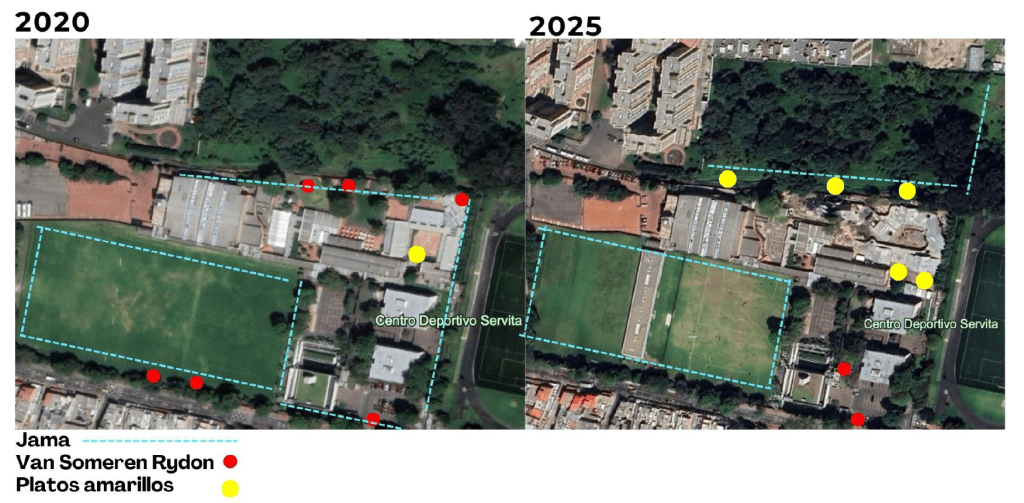
Figure 1. Map of the study area showing the zones and collection techniques used in 2020 and 2025. Red dots indicate Van Someren–Rydon traps, yellow dots indicate yellow pan traps, and blue dashed lines indicate entomological-net transects. Note the construction of the new Preschool in the upper-right corner and the CTC between soccer fields 2 and 3.
Fieldwork. Collections were conducted from November 26, 2024, to February 25, 2025. Three sampling techniques were used (Figure 2):
- Entomological net: 80-minute free-ranging surveys conducted once a week in both habitat-cover areas to capture flying insects.
- Van Someren–Rydon traps: three traps randomly distributed in the Open Area and baited with fish (replaced as needed), checked twice daily (07:00 and 10:00).
- Yellow pan traps: six dishes containing a solution of water, soap, and 75% ethanol, checked twice daily (07:00 and 10:00). They were placed in the Preschool Area, near sites used in 2020, and in the adjacent forest.
Laboratory work
Specimens were preserved in 75% ethanol in glass vials, except Lepidoptera, which were kept in glassine envelopes (Villarreal et al., 2004). When representative specimens of a lepidopteran species were already available, new records were photographed, counted, and released. Specimens were mounted and labeled following Samways et al. (2010) and identified to the lowest possible taxonomic level using specialized literature (Amarillo & Andrade, 1995; Wolff, 2006) and the iNaturalist application (https://www.inaturalist.org). All specimens were deposited in the Javeriano Museum of Natural History (MPUJ), Pontificia Universidad Javeriana.
Assignment of trophic guilds and relationship with vegetation.
Guilds were assigned according to Koch et al. (2019), defining a “guild” as a group of species that share and exploit a resource in a similar way. The following guilds were recognized: detritivores, nectarivores, predators, herbivores, and fruit, seed, and stem borers. The relationship between guild composition and vegetation recorded in each habitat-cover area was also analyzed.
Statistical analysis.
Sampling efficiency and representativeness were assessed using species accumulation curves in EstimateS 9.1.0 (Colwell, 2013), with the CHAO2 and ICE estimators (Villarreal et al., 2004).
Figure 2. Fieldwork conducted in 2025, showing the three sampling techniques used.
RESULTS AND DISCUSSION
Entomofaunal composition. A total of 344 insects belonging to seven orders, 29 families, and 45 species/morphospecies were collected (Table 1). Regarding collection methods, 321 specimens were collected using an entomological net, 15 using Van Someren–Rydon traps, and 8 using yellow pan traps. These results are consistent with the 2020 sampling, in which the entomological net captured the greatest diversity and abundance of species, followed by Van Someren–Rydon traps and, finally, yellow pan traps.
The two insect species with the highest number of individuals were Leptophobia aripa (Boisduval, 1836) and Stehlikiana crassa Walker, 1851, with 70 and 50 individuals, respectively. The first is a common butterfly frequently recorded in urban and peri-urban areas of Bogotá (Durán & Molina, 2020). Its caterpillars feed on plants in the family Brassicaceae (e.g., cabbage, kale, broccoli, and cauliflower), and it is commonly found in the school garden, where plants such as rugula and lettuce grow. In the forest area, this species finds an abundant food supply because the area is largely invaded by the creeping and climbing squash species Cucurbita ficifolia Bouche, 1837. It is important to note that this butterfly is associated with land conversion for agricultural production and is a negative indicator of ecosystem transformation by human activity (Campos Quintero, 2024). The second species, a jumping leafhopper in the family Cicadellidae, was abundant in the forest area, also due to its association with squash, on whose sap it feeds.
Five years ago, the school’s entomofauna consisted of 644 insects belonging to eight orders, 39 families, and 68 species/morphospecies (for the complete list, see Gómez et al. 2021). Since the initial characterization, the school’s insect fauna has undergone notable changes across several orders, suggesting ecological transformations associated with environmental modifications and ongoing urbanization within the institution. In Coleoptera, the absence of families such as Coccinellidae and Ptiliidae, together with the appearance of new Carabidae and Scarabaeidae species, may reflect changes in habitat structure and the availability of microhabitats and trophic resources. Several studies have shown that beetle communities are sensitive to variation in vegetation cover and soil quality, and act as bioindicators of environmental disturbance (McIntyre, 2000; Gómez-Bernal et al., 2019). The persistence of Curculionidae suggests some stability in the vegetation components of the area, as these herbivores are often associated with specific host plants (in this case, campus ivy, Hedera helix L.).
In Lepidoptera, the loss of families such as Crambidae and Tortricidae and the decline in Geometridae species may be associated with a reduction in host plants or changes in night-time lighting, factors that particularly affect nocturnal Lepidoptera (Lizée et al., 2011). Conversely, the increase in Sphingidae records may be interpreted as an indicator of ecosystem resilience, since this group includes species with high dispersal capacity and adaptability (Triplehorn & Johnson, 2005). The persistence of families such as Nymphalidae, Pieridae, and Hesperiidae indicates that the school’s green spaces continue to provide floral resources and suitable shelter for butterflies, consistent with literature highlighting the importance of small urban green fragments for pollinator conservation (Gómez-Bernal et al., 2019).
For Hemiptera, the absence of families such as Aphalaridae, Psyllidae, and Aphididae, and the decline in Membracidae, may be due to the removal of host plants or ornamental garden management that reduces vegetation heterogeneity. However, the persistence of Cicadellidae and Miridae, together with the appearance of Coreidae, suggests species replacement within the group, a common phenomenon in urban environments where taxonomic turnover occurs rather than a net loss of diversity (McIntyre, 2000).
In Hymenoptera, the loss of Figitidae and the addition of Halictidae may be related to changes in soil structure and the availability of nesting substrates. The persistence of Apidae and Formicidae demonstrates the ability of these groups to remain in disturbed environments due to their ecological flexibility and functional roles in pollination and decomposition (Lizée et al., 2011).
Finally, Diptera show a substantial reduction in the number of families recorded compared with 2020, which may be associated with a decrease in available organic matter or the management of moist microhabitats. Nevertheless, the persistence of Bibionidae, Drosophilidae, Muscidae, and Syrphidae suggests that the environment still contains sufficient microhabitats to support saprophagous and pollinating groups. In contrast, the absence of new records may indicate landscape homogenization or reduced habitat heterogeneity (Gómez-Bernal et al., 2019).
Among the less represented orders, the absence of Neuroptera, Psocoptera, and Thysanoptera, together with an increase in Odonata and Orthoptera species, may reflect changes in humidity, vegetation type, and improvement of the forest water body (which now contains rainwater rather than sewage). Odonata in particular often benefit from better water management, whereas Orthoptera may thrive in open areas with greater herbaceous cover (McIntyre, 2000). These results suggest that the school grounds have shifted from supporting a diverse and specialized insect community toward one dominated by more generalist groups adapted to urbanized environments.
Entomofaunal composition by trophic guilds and their relationship with vegetation in the habitat-cover areas. The trophic-guild composition of the Gimnasio Campestre entomofauna has changed considerably over the past five years. In 2020, nectarivores were the most diverse guild, with 22 species (32.4%), followed by mixed-diet species (17.6%) and herbivores (17.6%) (Gómez et al., 2021) (Figure 3). In the 2025 monitoring survey, nectarivores remained the dominant guild, although their relative proportion increased, while mixed-diet, fungivorous, and hematophagous guilds were no longer recorded. This pattern suggests that, despite landscape changes, flower-associated insects remain the most abundant group and are likely resilient, possibly due to the persistence of plant species with continuous flowering in areas surrounding the campus and the adjacent forest.

Figure 3. Trophic-guild richness of the entomofauna collected at Gimnasio Campestre, Usaquén, Bogotá, Colombia, in 2025.
The decline in the richness of guilds such as herbivores and detritivores may be explained by changes in vegetation cover following construction of the new Preschool and CTC building, which reduced structural heterogeneity and the availability of microhabitats. Guzmán-Mendoza et al. (2016) note that plant morphology and diversity determine the abundance of these groups, which depend directly on native plant resources. The reduction of native herbaceous plants and shrubs, replaced by hard surfaces or isolated green patches, may have limited insects that depend on specific plant tissues (Cárdenas-López et al., 2017).
Table 1. List of entomofauna recorded at Gimnasio Campestre in Usaquén, Bogotá, Colombia. Order, family, species or morphospecies, habitat-cover area, collection method, and corresponding abundance are shown.

Predators and borers, on the other hand, maintained similar proportions between 2020 and 2025, although their overall abundance remains low. This is consistent with Loya-Ramírez et al. (2003), who argue that low urban habitat connectivity and physical barriers, such as roads and buildings, restrict the movement of predatory insects. However, the persistence of this guild suggests some degree of ecological stability and resilience in the area’s trophic assemblage.
Overall, the results show how urbanization and vegetation changes alter the functional composition of urban insect fauna. Nectarivores, favored by ornamental plants and prolonged flowering, have become the dominant group, whereas guilds dependent on native vegetation or decomposing organic matter have declined, indicating a loss of ecological complexity in the campus insect assemblage (Durán-Prieto et al., 2020). These changes highlight the importance of conserving and restoring native vegetation in urban environments as a key strategy for maintaining insect functional diversity and the ecosystem services they provide.
Entomofaunal composition and structure across habitat-cover areas. Species richness at the institution was estimated using a species accumulation curve. The Chao 2 estimator predicted approximately 64 species, while ICE predicted 86. The estimators did not converge with the observed species richness, indicating that sampling effort was insufficient for the study area using the methods employed (Jiménez-Valverde & Hortal, 2003) (Figure 4).

Figure 4. Species accumulation curve for the sampling survey. The CHAO 2 and ICE estimators, as well as the “singletons” and “doubletons,” are shown.
Although sampling effort in 2025 was greater in terms of duration, the richness estimators did not converge with the observed species count, unlike in 2020. This difference is not attributable solely to sampling duration, but also to changes in the structure and composition of the insect community. In 2020, the rapid decline in unique species and increase in duplicates allowed the estimators to converge, indicating that most species present had been detected using the methods employed. In contrast, in 2025, the persistence of rare species and the lack of convergence between Chao2 and ICE suggest a more fragmented community, with lower population abundance and a higher proportion of transient species, characteristics common in disturbed urban ecosystems. According to Jiménez-Valverde and Hortal (2003), this pattern is typical of disturbed environments, where species detectability decreases and sampling design and techniques must be adjusted to achieve a more complete representation of biodiversity.
Regarding entomofaunal composition by area and sampling year, marked differences were observed in both diversity and abundance of recorded organisms (Table 2). In 2020, the Open Area had the highest number of orders, families, and species, which may be associated with greater habitat heterogeneity and a broader distribution of traps in this area. In contrast, the Garden Area had lower taxonomic richness but high total abundance, suggesting dominance by a few species with high population densities. In 2025, the Open Area retained the same number of orders (7), but showed a decrease in families (27) and species (41) compared with 2020, despite an increase in total abundance (323 individuals). This may indicate changes in community structure, with lower diversity but greater representation of certain species. The Preschool Area had a more restricted composition, with 5 orders, 8 families, 8 species, and considerably low abundance (21 individuals), which may be related to the smaller sampled area (due to landscape changes associated with the new building) and lower microhabitat diversity (isolated green patches).
Table 2. Richness and abundance of entomofauna recorded in the sampled areas at Gimnasio Campestre, Usaquén, Bogotá, Colombia, in 2020 and 2025.
| Variables | 2020 Open Area | 2020 Garden Area | 2025 Open Area | 2025 Garden Area |
|---|---|---|---|---|
|
No. of orders |
7 |
4 |
7 |
5 |
|
No. of families |
33 |
11 |
27 |
8 |
|
Richness |
60 |
12 |
41 |
8 |
|
Abundance |
294 |
350 |
323 |
21 |
CONCLUSIÓN
The entomological monitoring conducted at Gimnasio Campestre shows that, despite structural and vegetation-cover changes over the past five years, the school continues to host diverse insect fauna representative of urban ecosystems in Bogotá. The persistence of several key orders, families, and trophic guilds, particularly in the Open Area, confirms the importance of institutional green spaces as biodiversity refuges in highly disturbed urban settings. However, the observed reduction in taxonomic richness, together with the lack of convergence among richness estimators, suggests that the insect community currently has a more simplified and possibly more dynamic structure, influenced by disturbance and vegetation changes.
The marked differences between habitat-cover areas highlight the fundamental role of habitat heterogeneity and vegetation structural complexity in maintaining insect diversity. While the Open Area continues to harbor the greatest richness and diversity of trophic guilds, the Preschool Area showed low richness and abundance, which may be attributed to its smaller size, lower plant diversity, and recent transformation. These results reinforce the need to incorporate ecological criteria into the planning and management of the school’s green spaces, prioritizing the conservation and restoration of microhabitats that support different functional insect groups.
From a methodological perspective, the comparison between 2020 and 2025 demonstrates that sampling duration alone does not guarantee greater inventory representativeness. Sampling efficiency depends on habitat stability, trap spatial distribution, the diversity of methods used, and consistency in sampling locations. Future studies should therefore adopt a more standardized, long-term sampling design, with particular emphasis on temporal repetition, the inclusion of additional methods (e.g., light traps or nocturnal surveys), and stronger monitoring efforts in areas with less vegetation cover.
Finally, this study highlights the considerable value of entomology as a pedagogical tool for teaching research skills in school settings. Active monitoring involving students and the educational community not only contributes to local scientific knowledge but also strengthens key competencies such as systematic observation, data recording, critical analysis, and interpretation of results. It also fosters a closer and more mindful relationship with urban biodiversity, encouraging stewardship, a sense of place, and informed decision-making. Continued participatory entomological monitoring at the school thus represents a strategic opportunity to connect research, education, and conservation, establishing the institution as a model for experiential science education and community-based science.
REFERENCIAS
Amarillo, A. & Andrade, G. (1995). Clave Sinóptica para las familias y subfamilias de mariposas y polillas colombianas. En: Insectos de Colombia: Estudios escogidos. Academia Colombiana de Ciencias Exactas, Físicas y Naturales.
Cárdenas-López, D., Baptiste M.P. & Castaño N. (Eds). (2017). Plantas exóticas con alto potencial de invasión en Colombia. Instituto de Investigación de Recursos Biológicos Alexander von Humboldt. Bogotá D.C. 295pp.
Colwell, R. K. (2013). EstimateS, Version 9.1: Statistical Estimation of Species Richness and Shared Species from Samples (Software and User’s Guide).
Coral-Acosta, N., Castaño, J., Jiménez, D. & Urbina-Cardona, N. (2025). Scale-Dependent Effects of Landscape Heterogeneity on Butterfly Functional and Taxonomic Diversity in Andean Urban Parks. Ecology and Evolution 15 (10).
Duran, J. & Molina, A. G. (2020). Colores urbanos: Mariposas(Lepidoptera: Papilionoidea) de Bogotá Región (Colombia). Biota Colombiana, 21(2), 21–39.
Durán-Prieto, J., Tulande-Marín, E., & Ocampo-Flóres, V. (2020). Avispas (Insecta: Hymenoptera) asociadas a árboles urbanos de la ciudad de Bogotá, Colombia. Revista Chilena De Entomología, 46(4).
Gómez, M., Prada, L., Villota, F., Sarmiento, F. & González, B. (2021). Joyas de seis patas en la ciudad: inventario de la entomofauna del Gimnasio campestre (localidad de Usaquén, Bogotá, Colombia). El Astrolabio, 20:71-82 pp.
Gómez-Bernal, A., Ríos-Muñoz, C., & Sánchez-Clavijo, L. M. (2019). Biodiversidad urbana en Colombia: retos y oportunidades para la conservación. Instituto de Investigación de Recursos Biológicos Alexander von Humboldt.
Guzmán-Mendoza, R., Calzontzi-Marín, J., Salas-Araiza, M. D., & Martínez-Yáñez, R. (2016). La riqueza biológica de los insectos: análisis de su importancia multidimensional. Acta Zoológica. Mexicana (n.s.), 32(3), 370-379.
Hart, J. K., & Martínez, K. (2006). Environmental sensor networks: A revolution in the earth system science? Earth-Science Reviews, 78(3-4), 177-191.
Instituto Humboldt (2024). Monitoreo de la Biodiversidad Colombiana. 360 pp.
Jiménez-Valverde, A & Hortal, J. (2003). Las curvas de acumulación de especies y la necesidad de evaluar la calidad de los inventarios biológicos. Revista Ibérica de Aracnología. Vol 8, pp 151-161.
Koch BAE, Castaño-Meneses G, Delabie HCJ. (2019). El concepto de gremio: del feudalismo a la ecología de comunidades. Acta biol. Colomb., 24 (2), pp. 224-231.
Lizée, M. H., Manel, S., Mauffrey, J. F., Tatoni, T., & Deschamps-Cottin, M. (2011). Matrix configuration and patch isolation influences override the species–area relationship for urban butterfly communities. Landscape Ecology, 26(8), 1037–1048.
Loya Ramírez, J; García Hernández, J; Ellington, J & Thompson, D (2003). Impacto de la asociación de cultivos en la densidad de insectos hemípteros entomófagos. Interciencia, 28 (7), pp. 415-420.
McIntyre, N. E. (2000). Ecology of urban arthropods: a review and a call to action. Annals of the Entomological Society of America, 93(4), 825–835.
Sánchez-Clavijo, L. M., Rodríguez-Buriticá, S., & Serrano-García, M. E. (2024). Monitoreo participativo de la biodiversidad en Colombia: avances, retos y perspectivas. Instituto de Investigación de Recursos Biológicos Alexander von Humboldt.
Samways, MJ., Mac, MA., & New, TR. (2010) Insect Conservation. A handbook of approaches and methods. Oxford. pp. 441.
Triplehorn, C. A., & Johnson, N. F. (2005) Borror and DeLong’s introduction to the study of insects (7th ed.). Belmont, CA: Thomson Brooks/Cole.
Vallejo, M. I., & Gómez, D. I. (2017) Marco conceptual para el monitoreo de la biodiversidad en Colombia. Biodiversidad en la Práctica, 2(1), 1-47.
Villareal, H., Álvarez, M., Córdoba, S., Escobár, F., Fagua, G., Gast, F., Mendoza, H., Ospina M. y Umaña, A. (2004) Manual de métodos para el desarrollo de inventarios de la biodiversidad. Instituto de investigación en recursos biológicos Alexander Von Humboldt. pp. 236.
Wolff, M. (2006) Insectos de Colombia, Guía básica de familias. Universidad de Antioquia. pp. 460 pp.